

Key takeaway: Apple cider vinegar (ACV) can modestly lower blood sugar after meals and may improve insulin sensitivity, based on randomized controlled trials in adults with type 2 diabetes. It works by slowing digestion, not by acting like medication, and it's not a cure or a replacement for diabetes treatment. Most research uses 15 to 30 mL (one to two tablespoons) diluted in water, taken with or shortly before a carbohydrate-containing meal.
How Does Apple Cider Vinegar Affect Blood Sugar?
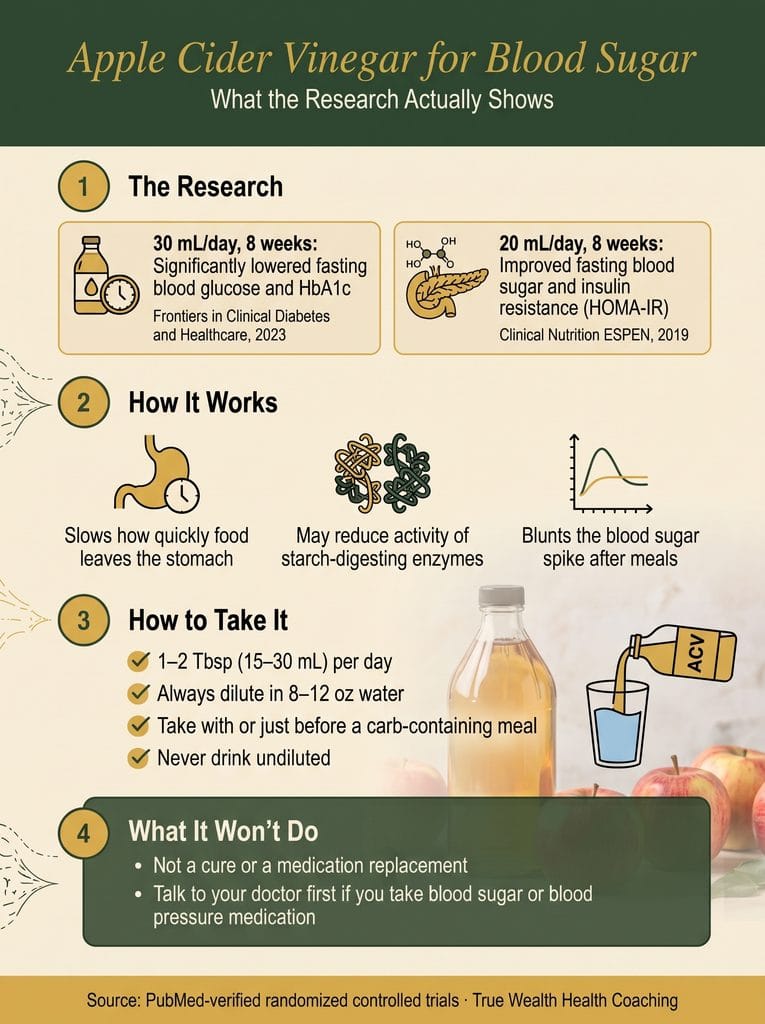
The active compound in ACV is acetic acid, and it appears to influence blood sugar in two main ways. First, it may slow gastric emptying, meaning food leaves the stomach more slowly, which spreads out how quickly sugar enters the bloodstream after a meal. Second, some research suggests it may reduce the activity of enzymes that break dietary starches down into glucose. Together, these effects tend to blunt the sharp rise in blood sugar after eating, rather than lowering blood sugar at rest as medication does.
What the Research Shows
Two randomized controlled trials in adults with type 2 diabetes give the clearest picture available right now.
A trial published in Frontiers in Clinical Diabetes and Healthcare followed adults with type 2 diabetes for eight weeks, during which Sima Jafarirad and colleagues at Ahvaz Jundishapur University of Medical Sciences in Iran gave one group 30 mL of apple cider vinegar daily alongside standard dietary guidance. Fasting blood glucose dropped significantly more in the ACV group than in the control group, and the two groups also differed significantly in hemoglobin A1C after eight weeks, along with improvements in LDL and total cholesterol in the vinegar group.
A separate eight-week trial by Alireza Gheflati and colleagues at Shahid Sadoughi University of Medical Sciences in Yazd, Iran, gave 70 adults with type 2 diabetes and dyslipidemia 20 mL of apple vinegar per day. Fasting blood sugar improved significantly in the vinegar group compared to control, along with markers of insulin resistance (HOMA-IR) and antioxidant activity. This trial appeared in Clinical Nutrition ESPEN.
For broader context, a systematic review and meta-analysis by Daniela Valdes and colleagues at Monash University in Australia, pooling 16 trials, found that dietary acetic acid supplementation reduced fasting blood glucose and triglycerides in people with type 2 diabetes, but did not produce significant changes in HbA1c, HDL cholesterol, or body weight measures. That review was published in the Journal of the Academy of Nutrition and Dietetics. Most individual trials, including the two above, are relatively short and modest in size, so the picture is promising rather than settled.
How Should You Take Apple Cider Vinegar to Lower Blood Sugar?
Most of the research above used 15 to 30 mL of ACV per day, which is roughly one to two tablespoons. That amount is always diluted, typically stirred into 8 to 12 ounces of water, never taken straight. A simple starting point is one tablespoon in a large glass of water, once or twice a day with meals.
When Is the Best Time to Take Apple Cider Vinegar for Blood Sugar?
Because ACV appears to work by slowing digestion and blunting post-meal spikes, taking it with or shortly before a carbohydrate-containing meal lines up with the mechanism researchers have proposed. Some people prefer a diluted glass in the evening before dinner, others in the morning with breakfast. The research doesn’t point to one time of day as superior, so consistency matters more than timing.
What Can You Mix With Apple Cider Vinegar for Blood Sugar Support?
Water is the baseline for dilution, and beyond that, ACV works well stirred into:
- Warm water with a squeeze of lemon
- A vinaigrette with olive oil for salads or roasted vegetables
- A marinade for vegetables, combined with olive oil
- A splash added to lentil, quinoa, or rice bowls
- Sparkling water with a few mint leaves for a refreshing option
Avoid mixing ACV with anything that encourages drinking it undiluted, and skip pairing it with very hot beverages, since heat isn’t necessary and can make the flavor harder to tolerate.
What Should You Never Do When Taking Apple Cider Vinegar?
Never drink ACV undiluted. Straight vinegar is acidic enough to erode tooth enamel and irritate the throat and esophagus with repeated use. Don’t use ACV as a substitute for prescribed diabetes medication, and don’t increase your dose expecting a bigger effect, since the research doesn’t support a strong dose-response relationship. If you take medication that lowers blood sugar or blood pressure, or a diuretic, talk with your doctor before making ACV a daily habit, since the combined effect could push levels lower than intended.
What About Cholesterol and Weight Loss?
Blood sugar control issues rarely occur without other symptoms. Many people working on glucose control are also watching cholesterol and weight, and the same two trials cited above offer a small amount of relevant data. In the Jafarirad trial, the ACV group saw significant reductions in LDL, total cholesterol, and cholesterol ratios, alongside improvements in blood glucose. Broader evidence on weight is weaker and more mixed; the Valdes meta-analysis found no significant effect on body weight across pooled trials. So ACV appears to be a modest, multifunctional addition for people managing both blood sugar and cholesterol, but not a reliable weight loss tool on its own.
What Apple Cider Vinegar Won’t Do
ACV is not a detox agent, a cure for infections, or a treatment for autoimmune conditions, and no reliable clinical trial evidence supports those uses. It also won’t meaningfully lower blood pressure or replace a balanced diet and appropriate medical care. The evidence that does exist points to something more specific and more modest: a small, consistent supporting role for blood sugar around meals, on top of, not instead of, the fundamentals.
A Bit of History, and What “The Mother” Really Means
Vinegar’s use as a health remedy goes back thousands of years, from Egyptian urns dating to roughly 3000 B.C. to Hippocrates prescribing vinegar-based remedies. Raw, unfiltered ACV contains “the mother,” a cloudy colony of acetic acid bacteria and cellulose formed during fermentation. Most clinical research has studied acetic acid itself rather than the mother specifically, so choosing raw, unfiltered ACV is a reasonable, minimally processed choice, but the blood sugar research applies to acetic acid whether or not the mother is present.
Frequently Asked Questions
Does apple cider vinegar lower blood sugar after a meal?
Randomized controlled trials suggest it can modestly reduce post-meal blood sugar spikes and improve fasting glucose over several weeks of consistent use, though the effect is small, not a substitute for medication.
How much apple cider vinegar should I take for blood sugar?
Most research uses 15 to 30 mL (one to two tablespoons) per day, diluted in water and taken with meals.
Can apple cider vinegar lower blood sugar immediately?
No. The research shows changes over weeks of consistent daily use, not an immediate drop after a single dose.
What should you never do while taking apple cider vinegar?
Never drink it undiluted, since it can erode tooth enamel and irritate the throat and esophagus, and never use it as a replacement for prescribed medication.
Should you drink apple cider vinegar with warm or cold water?
Either works. The research doesn’t show a difference based on water temperature, so use whichever you’ll stick with consistently.
The Bottom Line
Apple cider vinegar has a small, real, research-backed role in supporting healthy blood sugar responses around meals. It works by slowing digestion, not by acting like medication, and it’s best thought of as one supporting habit within a broader approach to metabolic health, not a stand-alone fix.
If you’d like more simple, evidence-based habits like this one, download our free guide, 10 Simple Ways to Support Healthy Metabolism, for more everyday strategies you can start using today.
And if you want a clearer picture of where your own blood sugar and metabolic markers stand, our lab testing and interpretation service walks you through your numbers and what they mean for you, paired with one-on-one coaching through True Wealth Health Coaching to help you build a plan around them.