

Meta description: Ten foods backed by randomized controlled trials for lowering blood pressure naturally, from flaxseed to beets, with the mechanism behind each one.
Blood pressure is called the “silent killer” for a good reason. You can’t feel it, and you don’t know it’s high unless someone measures it. And yet, uncontrolled high blood pressure is quietly damaging your arteries, your kidneys, and your heart every single day.
About 1.3 billion people around the world have hypertension. The World Health Organization calls it the single most important risk factor for early death worldwide. High blood pressure is responsible for 10.8 million preventable deaths every year, so it’s a very large problem.
As we get older, people experience what doctors call “essential hypertension.” They can’t put their finger on exactly what the cause is, but we have ideas and clues from what actually works. The foods we eat have a powerful and well-documented effect on blood pressure.
Blood pressure does not have to rise “essentially” as you get older. That’s largely due to diet and lifestyle factors. Food has a very powerful effect, and randomized controlled trials have shown double-digit drops in systolic blood pressure from specific foods.
Over the years, I’ve spent a lot of time reviewing research on diet and blood pressure, looking for foods that would be particularly beneficial. I found a handful of standouts that really perform well, and they work by different mechanisms, so the results are additive. They don’t have side effects like drugs do. They have side benefits.
So here are the 10 foods with real clinical evidence to back them up.
What You Need to Understand Before the List
Your blood pressure is not a fixed number. It responds dynamically throughout the day to dozens of inputs: what you eat, how you sleep, how much you weigh, what you’re stressed about at the moment, and the health of your blood vessels.
The three main mechanisms by which food lowers blood pressure are:
Nitric oxide production. Certain foods are rich in nitrates or compounds that help your blood vessels produce nitric oxide, which causes them to relax and widen.
Inflammation reduction. Chronic low-grade inflammation stiffens blood vessel walls. Anti-inflammatory foods reduce the stiffness.
Endothelial function. The inner lining of your blood vessels, the endothelium, regulates constriction and dilation. Several foods directly support endothelial health.
As I mentioned above, different foods work through different mechanisms, so they can combine to give you an additive effect.
1. Flaxseeds: The Most Underrated Blood Pressure Food on the Planet
I’m going to start here with flaxseeds, because most people don’t know about them, and you really should if you’re struggling with high blood pressure.
The landmark FLAX-PAD trial, led by Drs. Rodriguez-Leyva and Pierce at the University of Manitoba, enrolled 110 adults with peripheral artery disease in a randomized controlled trial. Participants consumed either 30 grams of ground flaxseed daily or a placebo, baked into bagels, muffins, and pasta so neither group knew what they were getting. The trial ran for six months.
The results were remarkable. In participants who started the trial with systolic blood pressure above 140 mm Hg, those eating flaxseed dropped their systolic pressure by an average of 15 points. Diastolic dropped by 7 points. These are not small changes. That reduction is clinically significant, comparable to what doctors expect from prescription medications.
A second randomized trial published in 2021, in which participants consumed 30 grams of ground flaxseed daily for 12 weeks, also showed a significant drop in systolic blood pressure over time in the flaxseed group, while the placebo group’s blood pressure went up.
How does flaxseed do this? Through multiple mechanisms working together. The omega-3 fat ALA reduces inflammation and supports nitric oxide production in blood vessel walls. The lignans in flaxseed, a class of phytoestrogens found in higher concentration in flax than any other food, have their own blood pressure-lowering effect, confirmed in a separate lignan-enriched complex trial. Magnesium in flaxseed (about 123 mg per 30-gram serving, or about 30 percent of your daily need) supports vascular relaxation. The fiber supports overall cardiovascular health.
In a comparison against hypertensive drugs, the best drug combinations, typically three or four medications used at low doses, reduce systolic blood pressure by about 18 mm Hg. Flaxseed’s 15-point reduction puts it in the same league, without the side effects.
How to use it: Grind 30 grams (about 3 tablespoons) of flaxseed daily and add it to smoothies, oatmeal, muffins, or salads. It needs to be ground, not whole, for your body to absorb the active compounds.
If you take nothing else away from this article, this is the number one thing to do: start taking flaxseed today.
2. Beets: Fast-Acting Nitric Oxide from Your Plate
Beets are famous for their nitrate content, and for good reason. Dietary nitrates from beets are converted by bacteria in your saliva into nitrite, and then by your body into nitric oxide, the same molecule that relaxes and widens your blood vessels.
This mechanism is fast. A highly cited randomized controlled trial by Kapil, Khambata, Robertson, and colleagues at Barts and the London School of Medicine, published in Hypertension in 2015, showed that daily supplementation with dietary nitrate from beetroot juice produced sustained blood pressure reductions in hypertensive patients over four weeks, with systolic blood pressure dropping by an average of 7.7 mm Hg compared to placebo.
What’s notable about this study is the word “sustained.” Many trials show a short-term drop in blood pressure right after a person drinks beet juice, and it does drop blood pressure quickly. But it keeps working as long as you keep drinking it.
The combination of beets, spinach, and carrots in a fresh juice is one of the best nitric oxide delivery systems available from food. Spinach is one of the highest-nitrate vegetables, gram for gram. Carrots add antioxidants that protect nitric oxide from being broken down before it can do its work. Fresh juice reacts with the bacteria in your mouth instantly, which gives you excellent conversion of nitrate to nitric oxide once it’s in your body. The synergy of these three vegetables is greater than any of them alone.
How to use it: Fresh juice of beets, carrots, and spinach is ideal. If you don’t have time to juice daily, a concentrated beet powder mixed into water delivers the same nitric oxide pathway in about two minutes.
3. Leafy Greens: The Nitrate Powerhouse Most People Overlook
People think of beets as the nitrate food. But leafy greens like arugula, spinach, Swiss chard, kale, and watercress are actually among the highest dietary sources of nitrates available.
Arugula, in particular, contains nitrate concentrations that rival beet juice in several analyses. A 100-gram portion of arugula provides roughly 480 mg of nitrate. Spinach is not far behind. These levels are high enough to produce the same nitric oxide pathway that beet juice studies have demonstrated.
A comprehensive review of nitrate-rich vegetables and blood pressure by Lidder and Webb, published in the British Journal of Clinical Pharmacology, concluded that regular consumption of nitrate-rich vegetables was associated with significant reductions in blood pressure, and that the effect appeared to accumulate with consistent daily intake.
This is one reason a large daily salad is such a smart habit from a cardiovascular standpoint. If the base of that salad is arugula, baby spinach, or spring mix, you’re delivering a meaningful nitrate dose every single day.
How to use it: Make arugula, spinach, or spring mix the base of your daily salad. Aim for at least two large handfuls. Lightly cooked leafy greens work too. The nitrates themselves are heat-stable.
4. Berries: Polyphenols That Protect Your Blood Vessels
Berries work through a different mechanism than nitrate-rich vegetables or flaxseeds. They’re rich in polyphenols, particularly anthocyanins, which improve endothelial function and reduce arterial stiffness.
A large prospective study by Cassidy, O’Reilly, Kay, and colleagues at the Harvard School of Public Health, published in the American Journal of Clinical Nutrition in 2011, followed over 156,000 women and men across three cohorts for 14 years. Participants with the highest anthocyanin intake, mostly from blueberries and strawberries, had an 8 percent lower risk of developing hypertension compared to those with the lowest intake, and that risk reduction rose to 12 percent in participants 60 and younger. The researchers attributed this specifically to anthocyanin content.
A more targeted intervention study by Basu and colleagues at Oklahoma State University found that consuming 50 grams of freeze-dried strawberries daily for eight weeks significantly reduced systolic blood pressure in adults with metabolic syndrome, along with reductions in LDL cholesterol and inflammatory markers.
Berries aren’t going to drop your blood pressure 15 points the way flaxseed can. But they are protecting the structural integrity of your blood vessel walls over time, and reducing the inflammation that makes hypertension worse. They’re doing long-term work.
How to use it: One cup of mixed berries daily, fresh or frozen, in smoothies, oatmeal, or on their own. Frozen blueberries are one of the most affordable and nutritionally consistent ways to meet this target.
5. Garlic: A Clinically Validated Natural ACE Inhibitor
Garlic has been used medicinally for thousands of years, but modern research has provided a mechanistic explanation for how it lowers blood pressure. The active compound allicin, produced when garlic is crushed or chopped, acts similarly to ACE inhibitor drugs. Allicin blocks the enzyme that converts angiotensin I to angiotensin II, a potent constrictor of blood vessels. This is a different mechanism than the ones seen with flaxseed, nitric oxide-rich vegetables, or berries.
A 2008 systematic review and meta-analysis by Ried and colleagues at the National Institute of Integrative Medicine in Australia, published in BMC Cardiovascular Disorders, pooled data from 11 randomized controlled trials (out of 25 studies reviewed) and found that garlic supplementation reduced systolic blood pressure by an average of 4.6 mm Hg compared to placebo across all participants. The effect was considerably larger in people who started the trial with hypertension: systolic pressure dropped by 8.4 mm Hg and diastolic by 7.3 mm Hg in that subgroup.
The effective dose in most trials was roughly equivalent to two to four cloves of garlic per day, or aged garlic extract supplements. Raw garlic, crushed and allowed to rest for 10 minutes before eating, maximizes allicin production.
How to use it: Crush two cloves of garlic, let them sit for 10 minutes, and add to salad dressings, vegetable dishes, or soups. Consistent daily use is the key, not just occasional use.
6. Oats: Soluble Fiber That Lowers Both Cholesterol and Blood Pressure
Oats contain beta-glucan, a soluble fiber that does two things particularly well: it lowers LDL cholesterol, and it lowers blood pressure in at least some people.
A randomized controlled trial by Maki and colleagues, published in the European Journal of Clinical Nutrition in 2007, tested foods containing oat beta-glucan against control foods over 12 weeks in adults with elevated blood pressure. Across the full group, blood pressure did not differ significantly between the beta-glucan and control diets. But among participants with a body mass index above 31.5, the oat beta-glucan group showed significant drops in both systolic (8.3 mm Hg) and diastolic (3.9 mm Hg) blood pressure compared to controls, along with improvements in post-meal insulin response.
The mechanism involves multiple pathways: beta-glucan feeds gut bacteria that produce short-chain fatty acids with anti-inflammatory effects, reduces the absorption of compounds that elevate blood pressure, and improves insulin sensitivity, which itself helps regulate blood pressure.
How to use it: Half a cup of rolled oats or steel-cut oats daily, cooked as a hot cereal or made into granola.
7. Pomegranate: The Fruit That Works Like an ACE Inhibitor
Pomegranate is one of the more powerful polyphenol foods for blood pressure. Several well-designed trials have shown significant blood pressure reductions from consistent pomegranate consumption, and researchers have identified the mechanism.
A study by Aviram and Dornfeld at the Technion-Israel Institute of Technology, published in Atherosclerosis in 2001, was one of the first to demonstrate that pomegranate juice reduced systolic blood pressure by 21 percent in hypertensive patients over two weeks, and that the mechanism included inhibition of ACE enzyme activity, the same target as ACE inhibitor drugs.
A 2016 systematic review and meta-analysis by Sahebkar and colleagues, published in Pharmacological Research, pooled 8 randomized placebo-controlled trials and confirmed consistent blood pressure-lowering effects, with an average systolic reduction of about 5 mm Hg and a smaller but significant diastolic reduction. By itself, that isn’t a dramatic drop, but when everything is combined together, these smaller reductions add up.
How to use it: A small glass (about 4 ounces) of pure pomegranate juice daily, or the fresh seeds. Avoid pomegranate products with added sugar, since the benefit comes from the polyphenols, not the sugar.
8. Legumes: Fiber, Potassium, and Magnesium in One Package
Legumes such as beans, lentils, and chickpeas contribute to blood pressure control through several different mechanisms. They’re one of the best sources of potassium in the diet, which directly counteracts the blood-pressure-raising effect of sodium. They’re rich in magnesium, which supports vascular relaxation. And the soluble fiber feeds gut bacteria that produce short-chain fatty acids with anti-inflammatory effects.
A meta-analysis by Jayalath and colleagues, published in the American Journal of Hypertension in 2014, analyzed eight randomized controlled trials involving legume consumption and found a significant reduction in systolic blood pressure compared to control diets.
The cardiometabolic benefits of a cup of beans per day are remarkably consistent across different populations and legume types, and the blood pressure benefit is part of a broader cardiovascular package.
How to use it: A half cup to a full cup of cooked legumes daily. Lentils are the easiest starting point since they don’t need soaking and cook quickly. Black beans, chickpeas, and pinto beans all work well.
Pro tip: Use an Instant Pot to cook your beans. The seasonings and flavor penetrate the beans better, and you get consistent results every time. Just rinse your beans a few times and cook them. No need to pre-soak for hours.
9. Walnuts: Omega-3 Fats and Arginine for Vascular Health
Walnuts are the one nut with significant omega-3 content, specifically ALA, the same plant-based omega-3 found in flaxseed. They’re also the richest nut source of arginine, the amino acid that serves as the raw material for nitric oxide production in endothelial cells.
A randomized crossover trial by Ros and colleagues at the Hospital Clinic in Barcelona, published in Circulation in 2004, found that replacing monounsaturated fat with walnuts in a cholesterol-lowering Mediterranean diet improved endothelium-dependent vasodilation, a direct measure of how well blood vessels relax and widen, compared to the standard Mediterranean diet. The walnut diet also produced an additional drop in LDL cholesterol.
A 2019 randomized controlled-feeding trial by Tindall and colleagues at Penn State University, published in the Journal of the American Heart Association, found that replacing saturated fat with walnuts (57 to 99 grams daily, depending on caloric needs) for six weeks significantly reduced central diastolic blood pressure compared to a diet that replaced the same omega-3 fat with oleic acid instead, with no significant change in central systolic blood pressure or arterial stiffness.
How to use it: A small handful of walnuts daily (about 1 to 1.5 ounces) as a snack, on top of salads, or blended into dressings.
10. Bananas and Avocados: Potassium as a Direct Blood Pressure Regulator
Potassium deserves its own entry because it works differently from all the other mechanisms above. Potassium directly helps your kidneys excrete sodium, which is the primary driver of high blood pressure for most people. The higher your potassium intake, the more efficiently your body manages sodium, and the lower your blood pressure tends to be.
The DASH diet, the most well-studied dietary intervention for hypertension in mainstream medicine, works largely through a combination of higher potassium, magnesium, and calcium intake alongside lower sodium. Bananas and avocados are two of the most potassium-dense foods available: a medium banana provides about 420 mg, and a medium avocado provides over 900 mg.
A meta-analysis by Aburto and colleagues, published in the BMJ in 2013, analyzed data from 33 trials and 128,000 participants and found that higher potassium intake was associated with a 24 percent lower risk of stroke and significant reductions in blood pressure in people with hypertension.
How to use it: One banana and a quarter to a half of an avocado daily provides a meaningful potassium contribution. Eating these consistently, alongside other high-potassium plant foods like sweet potatoes and beans, helps shift your sodium-to-potassium ratio in a favorable direction. And of course, cut out processed foods, which tend to be loaded with added sodium.
How to Get the Most from These Foods
These foods don’t have to be exotic or expensive. Most of them are ordinary pantry staples. Here’s a practical framework for incorporating them:
Start your morning with ground flaxseed. Thirty grams in your smoothie or stirred into oatmeal. Make this non-negotiable. It’s the single highest-impact dietary intervention for blood pressure on this list.
Drink your vegetables. A daily glass of fresh carrot, beet, and spinach juice delivers nitrate to the nitric oxide pathway very efficiently. If that’s not practical every day, a beet powder supplement gets the job done in about two minutes.
Build salads on leafy greens. Skip iceberg lettuce, since it doesn’t do much for you nutritionally. Arugula, spinach, and mixed greens with darker varieties are your nitrate base.
Eat a cup of legumes daily. As a side, in a burrito, on your salad, in a sandwich spread, or as soup. Find different ways to work beans into your daily diet and stay consistent about it.
Snack on walnuts and berries. This combination covers the omega-3, arginine, and polyphenol angles in one simple snack.
Use garlic daily. Crush it, let it sit, then cook with it. No supplement needed.
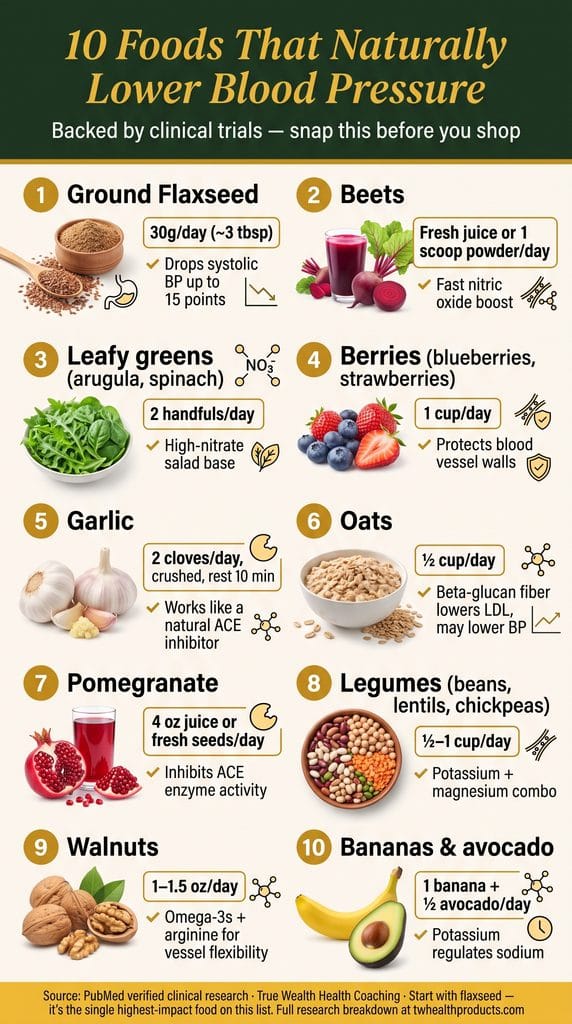
Save a copy of this infographic here for reference when you prepare your shopping list or upgrade your usual food intake.
The Bottom Line
None of these 10 foods are exotic or expensive. They’re all whole plants that have fed human beings for thousands of years, and now we have randomized controlled trial evidence explaining exactly why they’ve been protective.
I’ve met a lot of older adults over the years with normal blood pressure of 110/60. In this day and age, that’s abnormally normal. Most people their age have elevated blood pressure and are taking blood pressure medication. That’s only anecdotal, but it does suggest that at least some people can avoid high blood pressure quite well, and diet has a lot to do with it.
There’s also a piece of this that goes beyond food. Chronic stress raises blood pressure through its own well-documented pathway, and worry, unresolved anger, and bitterness all keep the body’s stress response switched on longer than it needs to be. Learning to release those things, through prayer, forgiveness, or simply working through what’s weighing on you, is part of a whole-person approach to blood pressure, not a replacement for the foods above, but a companion to them.
These 10 foods aren’t trendy supplements or food fads. They’re just the foods that feed the body the way it was designed to function.
If you are currently on blood pressure medication, don’t stop it without working with your physician. Some of these dietary changes are powerful enough to lower your blood pressure into a range where your medication dose can be adjusted. That’s a great problem to have, but it needs to be managed with your doctor, not instead of your doctor.
If you want a broader starting point for supporting your metabolic health beyond blood pressure specifically, our free guide, 10 Simple Ways to Support Healthy Metabolism, walks through additional habits that work alongside the foods above.
And if you’d like a closer look at your own numbers rather than general guidance, our metabolic lab testing service can help you see where you actually stand, and our True Wealth Health Coaching program can help you build a personalized plan around it.
Frequently Asked Questions
How quickly can food lower blood pressure?
Some foods work quickly. Studies on beet juice show measurable drops in blood pressure within hours of consumption. Others, like flaxseed, produce their largest effects at the 12-week and 6-month marks. The best approach combines fast-acting nitrate-rich foods for immediate support with consistent long-term dietary patterns for sustained improvement.
Can diet alone control high blood pressure without medication?
For some people with mildly elevated blood pressure, a comprehensive dietary and lifestyle overhaul can bring blood pressure into the normal range without medication. For people with more severely elevated blood pressure, diet is powerfully additive to medication and may allow doses to be reduced over time under medical supervision. Never stop or adjust blood pressure medications without consulting your physician.
Is it safe to eat these foods if you are already on blood pressure medication?
Yes, but with one important caution: some of these foods, particularly flaxseed and beet juice, are potent enough to produce meaningful blood pressure reductions. If you consistently add them to your diet, monitor your blood pressure and communicate with your physician. A lowering effect combined with medication could push blood pressure too low.
Which is more effective: beets or flaxseed for blood pressure?
They work through completely different mechanisms and produce additive effects when combined. Beets and nitrate-rich vegetables work through the nitric oxide pathway and act relatively quickly. Flaxseed works through omega-3 fatty acids, lignans, and magnesium, and builds to its largest effect over 12 weeks and beyond. Using both together is smarter than choosing one over the other.
References
Rodriguez-Leyva D, Weighell W, Edel AL, et al. Potent antihypertensive action of dietary flaxseed in hypertensive patients. Hypertension. 2013;62(6):1081-1089.
Kapil V, Khambata RS, Robertson A, Caulfield MJ, Ahluwalia A. Dietary nitrate provides sustained blood pressure lowering in hypertensive patients: a randomized, phase 2, double-blind, placebo-controlled study. Hypertension. 2015;65(2):320-327.
Cassidy A, O’Reilly EJ, Kay C, et al. Habitual intake of flavonoid subclasses and incident hypertension in adults. American Journal of Clinical Nutrition. 2011;93(2):338-347.
Basu A, Nguyen A, Betts NM, Lyons TJ. Strawberry as a functional food: an evidence-based review. Critical Reviews in Food Science and Nutrition. 2014;54(6):790-806.
Ried K, Frank OR, Stocks NP, Fakler P, Sullivan T. Effect of garlic on blood pressure: a systematic review and meta-analysis. BMC Cardiovascular Disorders. 2008;8:13.
Aviram M, Dornfeld L. Pomegranate juice consumption inhibits serum angiotensin converting enzyme activity and reduces systolic blood pressure. Atherosclerosis. 2001;158(1):195-198.
Sahebkar A, Ferri C, Giorgini P, Bo S, Nachtigal P, Grassi D. Effects of pomegranate juice on blood pressure: a systematic review and meta-analysis of randomized controlled trials. Pharmacological Research. 2016;115:149-161.
Jayalath VH, de Souza RJ, Sievenpiper JL, et al. Effect of dietary pulses on blood pressure: a systematic review and meta-analysis of controlled feeding trials. American Journal of Hypertension. 2014;27(1):56-64.
Maki KC, Galant R, Samuel P, et al. Effects of consuming foods containing oat beta-glucan on blood pressure, carbohydrate metabolism and biomarkers of oxidative stress in men and women with elevated blood pressure. European Journal of Clinical Nutrition. 2007;61(6):786-795.
Ros E, Núñez I, Pérez-Heras A, et al. A walnut diet improves endothelial function in hypercholesterolemic subjects: a randomized crossover trial. Circulation. 2004;109(13):1609-1614.
Tindall AM, Petersen KS, Skulas-Ray AC, Richter CK, Proctor DN, Kris-Etherton PM. Replacing saturated fat with walnuts or vegetable oils improves central blood pressure and serum lipids in adults at risk for cardiovascular disease: a randomized controlled-feeding trial. Journal of the American Heart Association. 2019;8(9):e011512.
Aburto NJ, Hanson S, Gutierrez H, Hooper L, Elliott P, Cappuccio FP. Effect of increased potassium intake on cardiovascular risk factors and disease: systematic review and meta-analyses. BMJ. 2013;346:f1378.
Lidder S, Webb AJ. Vascular effects of dietary nitrate (as found in green leafy vegetables and beetroot) via the nitrate-nitrite-nitric oxide pathway. British Journal of Clinical Pharmacology. 2013;75(3):677-696.