
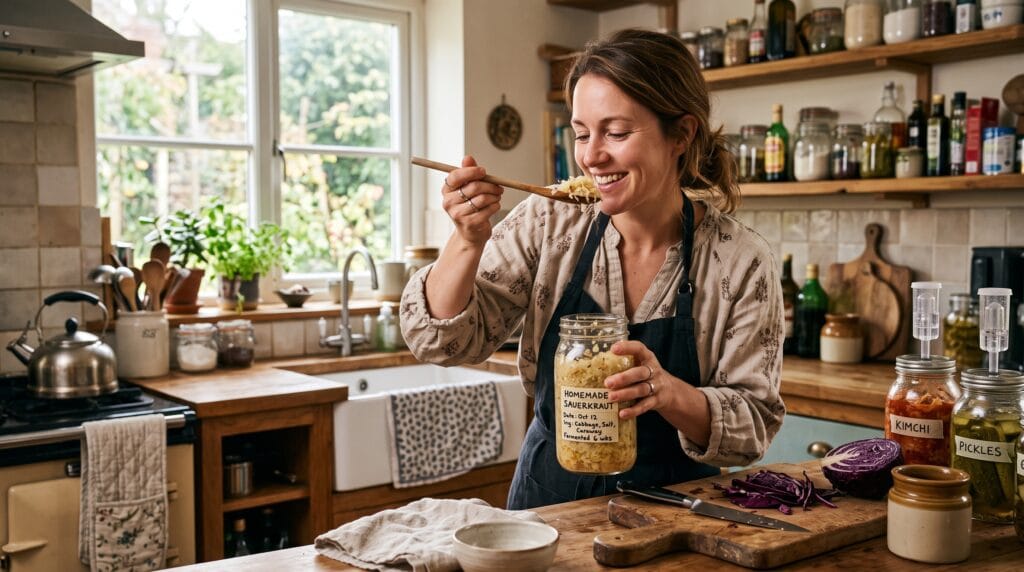
I remember the day nearly 30 years ago when I walked into a food research kitchen and two coworkers were shredding cabbage and putting together a batch of raw sauerkraut. Raw!
My childhood memories of sauerkraut come from every August, my mom shredding cabbage and sticking it into a big sauerkraut crock, letting it sit and ferment, and then canning it away for the year.
I didn’t know you could eat sauerkraut raw. I think I tried some of that raw sauerkraut, and it wasn’t too bad. But was it food, or was it a science experiment? My kids still think it’s a science experiment, one gone badly at that. And the stuff we can buy tastes better than the stuff I make.
Sauerkraut is indeed a food, and a very old-fashioned kind of food at that. Traditionally, it was how you could keep cabbage for months and have vegetables to eat when nothing was green in your garden. Long before anyone had conceived the word microbiome, people were packing cabbage away into crocks with salt and fermenting them. But now we can measure what’s actually happening in your gut when you eat this kind of food, and the picture is more interesting and more honest than most articles let on.
I’ll walk you through the fermentation science: what clinical trials have found, some good, some mixed evidence, how sauerkraut compares to kimchi and other fermented vegetables, and how you can make your own.
Let me explain what’s actually going on inside that jar.
What Fermentation Actually Does to a Vegetable
Fermentation is a controlled transformation. You submerge shredded cabbage or other vegetables in a salt brine, which creates a low-oxygen, salt-tolerant environment. Naturally occurring lactic acid bacteria, mostly from the Lactobacillus family, take over from there. They consume the natural sugars in the vegetable and convert them into lactic acid.
That lactic acid does two jobs at once. It preserves the vegetable by keeping spoilage organisms out, and it changes the food’s nutritional profile. You end up with a vegetable that’s lower in sugar, higher in certain organic acids, and populated with live bacteria, some of which survive the trip through your stomach acid and reach your intestines.
This is very different from pickling with vinegar. A vinegar pickle is preserved by an acid you add. A true ferment, like traditional sauerkraut or kimchi, is preserved by an acid the bacteria make themselves. Only the second kind delivers live cultures. That distinction on the jar label matters more than most shoppers realize.
The Bacteria Doing the Work
Lactobacillus plantarum is the workhorse species most associated with vegetable fermentation, and it shows up again and again in the research, in kimchi as well as in sauerkraut. Here’s the thing, though: it isn’t the bacterium that starts the job.
Raffaella Di Cagno’s team at the Free University of Bozen-Bolzano tracked sauerkraut’s bacterial community from the first day of fermentation straight through to the finish, using shotgun metagenomic sequencing, published in Microbiology Spectrum. The pattern held up clearly. Leuconostoc species and a lesser-known organism called Weissella dominate the first few days, while the brine is still mild. As the acid builds and the environment turns hostile to competitors, Lactobacillus plantarum takes over as the dominant species by the final stage. The team also picked up an overlooked player, Secundilactobacillus malefermentans, quietly doing real metabolic work in the later weeks, the kind of detail you’d only catch with gene sequencing instead of older culture-based methods.
Sauerkraut microbiology isn’t perfectly uniform jar to jar, or even day to day. Nelly Schropp’s team at the University of Freiburg sequenced the sauerkraut used in their trial, published in Microbiome, and found something more nuanced. Fresh sauerkraut was dominated by Lacticaseibacillus paracasei, making up over 95 percent of the bacterial community. But that composition kept shifting even after the jar was sealed and refrigerated. After seven weeks of cooled storage, still within the product’s expiration date, Limosilactobacillus reuteri had taken over as the dominant species, alongside lower levels of Leuconostoc mesenteroides and Weissella cibaria. Recipe, storage time, and regional starter cultures all shift which species wins out, and apparently so does time in your refrigerator. What holds steady across both studies is the broader succession pattern: an early phase led by different species depending on the batch, followed by a later, more acid-tolerant phase where Lactobacillus family species tend to take over. That succession is what turns raw cabbage into sauerkraut in the first place.
These bacteria also matter for a reason that goes beyond digestion. A healthy gut lining depends on tight junctions between cells, the same barrier that determines how well your gut wall holds up under stress. Fermented vegetables feed that barrier from the inside out.
What the Clinical Trials Actually Show
Here’s the thing. The research on fermented vegetables is more nuanced than most wellness articles let on. I’d rather give you the real picture than a simpler story that oversells it.
The landmark fermented food trial. In 2021, Hannah Wastyk and a Stanford research team led by Justin and Erica Sonnenburg published a 17-week randomized trial in the journal Cell comparing a high-fiber diet to a high-fermented-food diet. The fermented food group ate things like yogurt, kefir, kombucha, and fermented vegetables. The results were striking. The fermented food diet steadily increased gut microbial diversity and decreased four separate inflammatory markers, including interleukin-6. The high-fiber diet, at only 45 grams per day average fiber intake, did not significantly change the primary immune outcome the researchers measured. Let that sink in. A whole category of fermented foods, not a probiotic pill, measurably calmed inflammation in healthy adults.
Pull Quote:
The sauerkraut-specific trial. This is where honesty matters most. In February 2025, Schropp’s Freiburg team published a crossover trial of 87 healthy adults in the journal Microbiome, comparing four weeks of fresh sauerkraut to four weeks of pasteurized sauerkraut. The headline finding wasn’t what you’d expect. Overall gut microbial diversity barely budged in either group. The researchers described a healthy adult gut as “rather resilient” to four weeks of sauerkraut, even though individual bacterial species did shift. The real surprise: pasteurized sauerkraut, the kind with no living bacteria at all, was the version that significantly raised blood levels of the short-chain fatty acids acetate, propionate, and butyrate. Fresh sauerkraut did not produce the same rise as I would have expected and hoped.
I’m including that not to talk you out of eating sauerkraut, but because you deserve science reported the way it actually happened. Some of sauerkraut’s benefits may come from the fermentation byproducts themselves, what researchers now call postbiotics, not only from live bacteria taking up residence in your gut. That’s still a win. It just isn’t the win that the marketing usually promises. It could be that we need a few more clinical trials of sauerkraut to understand this fully. This was only one trial.
The kimchi trials. Kimchi has a longer track record of human trials, mostly out of Korea. Eun Kyoung Kim and colleagues ran a crossover study of 22 overweight and obese adults, published in Nutrition Research, comparing four weeks of fresh kimchi to four weeks of fermented kimchi. Both groups lost body weight and body fat, but the fermented kimchi group showed a significantly greater drop in waist-hip ratio and fasting blood glucose. A follow-up study by Kyungsun Han’s team, published in Molecular Nutrition & Food Research, found that fresh and fermented kimchi altered gut microbiota composition differently in obese Korean women. Fermentation time itself changes what a food does in your body, not just how it tastes. That’s worth remembering the next time a jar sits a little longer on your counter than planned.
Short-Chain Fatty Acids: The Real Payoff
Short-chain fatty acids, or SCFAs, are the metabolic currency your gut bacteria produce when they break down fiber and plant compounds. The three main ones, acetate, propionate, and butyrate, feed the cells lining your colon, help regulate inflammation, and play a role in blood sugar control. Butyrate in particular is fuel for the very cells that hold your gut barrier together.
You don’t need to memorize the biochemistry. Here’s what matters: the Freiburg sauerkraut trial found that fermented vegetables can raise circulating SCFA levels, and that effect showed up most clearly with pasteurized sauerkraut. So the fiber and postbiotic compounds, not just live bacteria counts, are doing real work here. Eating the vegetable matters. Whether or not every jar is teeming with live cultures by the time it reaches your plate, your gut still benefits.
Sauerkraut vs. Kimchi vs. Other Fermented Vegetables
| Food | Primary bacteria | Best-studied effect | Sodium consideration |
|---|---|---|---|
| Raw sauerkraut | Succession varies by batch. Early: Leuconostoc/Weissella or L. paracasei. Late: L. plantarum or L. reuteri | SCFA production, modest single-species shifts | Moderate |
| Kimchi | Lactobacillus plantarum and related species | Weight, waist-hip ratio, fasting glucose | Higher, watch portions |
| Fermented pickles (cucumber, other vegetables) | Lactobacillus species, varies by recipe | Gut microbiota and immune markers in community trials | Moderate to high |
| Kefir and yogurt | Lactobacillus, Bifidobacterium species | Increased microbial diversity, lower inflammation (Wastyk 2021) | Low |
| Kombucha | Yeast and bacterial culture (SCOBY) | Included in the Wastyk fermented food arm | Low |
A 2025 community trial by Sumbal Hafeez and colleagues at the Aga Khan University, published in Scientific Reports, deserves a mention here too. Researchers gave 230 women in rural Pakistan about 50 grams a day of various plant-based fermented pickles for 12 weeks and measured real improvements in gut microbiota composition and inflammatory markers. It’s a good reminder that this isn’t only a Western wellness trend. Fermented vegetables have supported gut health across cultures for a very long time, and the research is finally catching up to what people already knew from experience.
How to Make Fermented Vegetables at Home
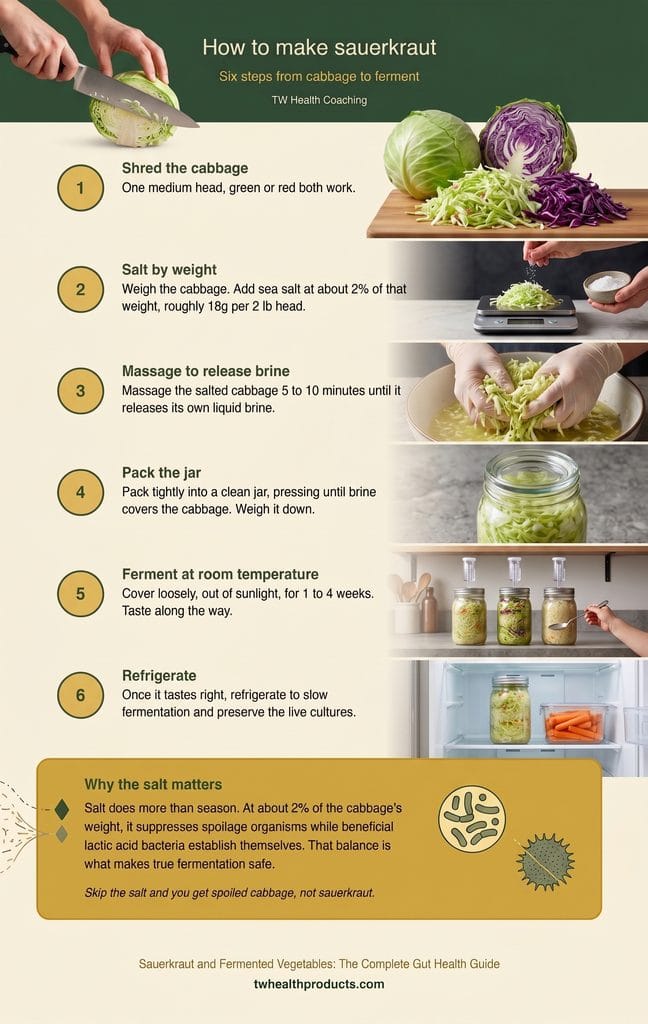
You don’t need special equipment to get started. Here’s a basic method for raw sauerkraut.
- Shred one medium head of cabbage. Green or red both work.
- Weigh the cabbage, then add sea salt at about 2 percent of that weight. For a 2-pound head, that’s roughly 18 grams of salt.
- Massage the salted cabbage for 5 to 10 minutes until it releases its own liquid brine. The salt pulls water out of the cabbage, making it softer and easier to pack into the jar.
- Pack it tightly into a clean jar, pressing until the brine covers the cabbage completely. Weigh it down with a fermentation weight or a smaller jar filled with water.
- Cover loosely and let it sit at room temperature, out of direct sunlight, for 1 to 4 weeks. Taste along the way. More time means more sour.
- Refrigerate once it tastes right to you. This slows fermentation and preserves the live cultures.
The salt matters more than people expect. It suppresses spoilage organisms while the beneficial lactic acid bacteria establish themselves, which is what makes true fermentation safe.
Here’s an infographic that you can save to your phone to refer to while you make your next batch of sauerkraut.
A Metabolic Health Perspective
Fermented vegetables aren’t a miracle food, and the honest research reflects that. What the trials do show, consistently, is a food category that can lower inflammatory markers, shift gut bacterial populations, and, in the case of sauerkraut specifically, raise the short-chain fatty acids your colon depends on. That’s meaningful, measurable support for a body that already does a great deal of its own repair work when it’s given the right raw materials. Clinical studies are always short. You can eat this way for months and years, and that kind of consistency changes your biology in ways a four-week trial can’t fully capture.
The gut bacteria this article covers do more than digest food. They influence inflammation, blood sugar regulation, and hormone metabolism throughout the body, which is part of why we treat gut health as foundational rather than a side topic in our coaching work.
This could be you: a body that produces its own butyrate, calms its own inflammation, and does it one jar at a time.
So turn over a new leaf, a cabbage leaf, that is, and try something different. Rather than relying on medications and making appointments in doctors’ offices, start by changing the foundation that your gut is working with: your food. Your initial exposure to raw sauerkraut might be like mine: “Is that a science experiment?” Sauerkraut done right is tangy and sour, but not off-flavored. But you’ll get used to it, and a little bit every day will get you going in the right direction.
Want a simple starting point for your gut and metabolic health? Download our free guide, 10 Simple Ways to Support Healthy Metabolism, for practical steps you can start today.
Curious what your own numbers are telling you? If you’ve had labs run and want help interpreting what they actually mean for your metabolic health, or you want a coach in your corner while you build habits like this one, book a discovery call and let’s look at your data together.
Sources
Tlais AZA, Lemos Junior WJF, Filannino P, Campanaro S, Gobbetti M, Di Cagno R. How microbiome composition correlates with biochemical changes during sauerkraut fermentation: a focus on neglected bacterial players and functionalities. Microbiology Spectrum. 2022;10(4):e00168-22. PMID: 35699432. DOI: 10.1128/spectrum.00168-22
Wastyk HC, Fragiadakis GK, Perelman D, et al. Gut-microbiota-targeted diets modulate human immune status. Cell. 2021;184(16):4137-4153.e14. PMID: 34256014. DOI: 10.1016/j.cell.2021.06.019
Kim EK, An SY, Lee MS, et al. Fermented kimchi reduces body weight and improves metabolic parameters in overweight and obese patients. Nutrition Research. 2011;31(6):436-443. PMID: 21745625. DOI: 10.1016/j.nutres.2011.05.011
Han K, Bose S, Wang JH, et al. Contrasting effects of fresh and fermented kimchi consumption on gut microbiota composition and gene expression related to metabolic syndrome in obese Korean women. Molecular Nutrition & Food Research. 2015;59(5):1004-1008. PMID: 25688926. DOI: 10.1002/mnfr.201400780
Schropp N, Bauer A, Stanislas V, et al. The impact of regular sauerkraut consumption on the human gut microbiota: a crossover intervention trial. Microbiome. 2025;13(1):52. PMID: 39940045. DOI: 10.1186/s40168-024-02016-3
Hafeez SH, Khalid A, Ahmed S, et al. Fermented pickles improve gut microbiota and immune profile in women in a community trial in rural Pakistan. Scientific Reports. 2025;15(1):34522. PMID: 41044104. DOI: 10.1038/s41598-025-17721-8