Key Takeaways
- The official fiber recommendation (25g/day for women, 38g/day for men) comes from a 2002 report that’s never been updated. The underlying research is even older.
- That number was built from typical Western diets, where almost nobody was eating past 35-40g a day, so it can’t tell us much about what happens above that range.
- Newer data on people who eat a lot more fiber points to real benefits well past the official minimum.
- Going vegetarian or vegan doesn’t automatically get you there. What matters is how much whole plant food you actually eat, not which foods you exclude.
- You don’t have to give up meat, dairy, or eggs to hit a high-fiber intake. You just have to eat a lot of plants alongside them.
How Much Fiber Do You Really Need to Lose Weight?
If you’ve looked this up before, you already know the standard answer: 25 grams a day for women, 38 grams for men. It’s on every health site, every nutrition label, every government chart.
Here’s what most of those sites won’t tell you: that number is a floor, not a target. And it was built on evidence that’s less robust and a lot older than most people realize.
The Official Fiber Recommendation (And Why It’s a Floor, Not a Goal)
The 25g/38g numbers come from something called an Adequate Intake, or AI. That’s different from an RDA. Most nutrients get an RDA because scientists can point to a clear deficiency disease and work backward from it. Not enough vitamin C causes scurvy, so researchers can calculate exactly how much prevents it. Fiber doesn’t work that way. There’s no fiber deficiency disease to measure against, so health authorities fall back on the next best thing: the AI.
For fiber, the fallback came from a handful of large-cohort studies from the 1990s that tracked people’s diets and heart disease rates over time. Three studies in particular showed that people eating around 14 grams of fiber per 1,000 calories had meaningfully lower rates of coronary heart disease. The Institute of Medicine used that figure to set the AI in 2002, and it hasn’t been revisited since. The number of sites still quoted today is closer to 30 years old at its roots.
Here’s the part that matters most: those cohort studies were built entirely from typical Western eaters. Even the highest fiber eaters in those groups rarely broke 35 to 40 grams a day. So the research couldn’t tell us anything about what happens above that level because almost no one in the data was eating that much.
Newer research fills in some of that gap. In the Adventist Health Study 2, median fiber intake climbed step by step as animal food intake dropped: 29.8 grams a day for non-vegetarians, 34.6 for semi-vegetarians, around 37 for pesco- and lacto-ovo vegetarians, and 46.4 for strict vegetarians, whose top eaters (the 95th percentile) were taking in over 61 grams a day. That same group, the strict vegetarians, also had the lowest average BMI and the lowest rate of obesity of any dietary pattern in the study. And coached whole-food plant-based programs push the number even further (more on that below).
None of this means the official AI is wrong. It’s a reasonable floor, built on real evidence, for a specific outcome: heart disease risk in typical eaters. It was just never designed to tell us what’s possible or beneficial above that floor.
What Fiber Intake Actually Looks Like on a Plant-Based Diet
Before you assume plant-based automatically solves the fiber question, you need to realize that not everyone is a vegetarian for health reasons. A systematic review published in Nutrients, pooling 141 studies of self-selected, everyday vegetarians and vegans, found vegetarians averaged only about 28 grams of fiber a day. That clears the AI for women, but falls short for men. Vegans averaged about 44 grams, clearing the AI, but not by a wide margin.
These aren’t people following a coached program. They’re general-population vegetarians and vegans, and their intake reflects it. Cutting out meat and dairy doesn’t automatically fill your plate with fiber-rich whole foods. It just removes two categories that never had fiber in them to begin with.
Is There a Higher, Better Target Than the RDA?
Now compare that to people who are actually coached toward a whole-food, plant-based way of eating. A study in Nutrients followed 151 adults through a structured whole-food plant-based lifestyle program for anywhere from 6 months to 10 years. Their average fiber intake: 70 grams a day. Nearly double the uncoached vegan average above, from people following the same broad dietary category.
The difference isn’t the label “plant-based.” It’s whether the diet is actually built around intact whole grains, legumes, vegetables, fruit, nuts, and seeds, in real volume, on purpose.
Do You Have to Be Vegan to Eat High-Fiber?
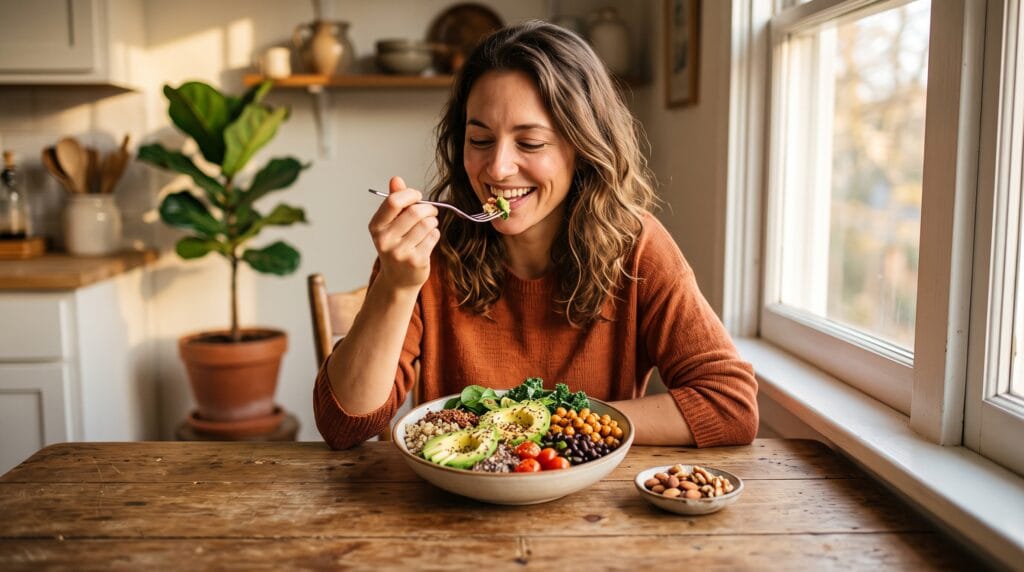
No. Fiber only comes from plants, but eating plants doesn’t require cutting out anything else. Every food on the list below fits comfortably into a diet that still includes meat, dairy, or eggs.
This actually connects back to the point above. If avoiding animal foods alone got people to a genuinely high fiber intake, the self-selected vegans in that Nutrients review would have landed well above 44 grams, not barely above it. The real driver isn’t exclusion. It’s the volume and variety of plant foods on the plate, meal after meal, whether or not anything else is on that plate too.
Why the Extra Fiber Matters for Weight Loss
Fiber slows digestion, which keeps you fuller longer. It also triggers hormones like GLP-1 that signal satisfaction to your brain, and it adds bulk that stretches the stomach just enough to register as “enough” before you’ve overeaten. None of that requires hitting some dramatic number. It just means more fiber, within reason, tends to work in your favor.
Five High-Fiber Foods to Get You There
Intact whole grains. Think steel-cut oats, farro, and brown rice, not flour-based products. Keeping the grain whole keeps the fiber intact too.
Nuts. A satisfying combination of fiber, protein, and healthy fat. Roughly 3-4 grams of fiber per small handful, depending on the nut.
Avocados. About 6-7 grams of fiber per half avocado, plus the kind of fat that helps you feel satisfied after a meal.
Flaxseeds and chia seeds. Both absorb liquid and form a gel in your gut, which is part of why they’re so effective at keeping hunger at bay. A tablespoon or two goes a long way.
Leafy greens. Low in calories, high in volume, and a steady source of fiber that you can eat in large amounts without much effort.
Frequently Asked Questions
How much fiber per day should I eat to lose weight?
The official minimum is 25g for women and 38g for men, but that number was built to protect against heart disease in typical Western eaters, not to define an ideal weight-loss target. Research on people eating well past that minimum, in the 45-70g range, points to real benefits without requiring an extreme diet.
Can you eat too much fiber?
Yes, if you increase intake too quickly. Add fiber gradually and drink enough water to avoid bloating or digestive discomfort.
Can you get enough fiber without being vegan?
Yes. Fiber comes exclusively from plant foods, but you don’t have to exclude meat, dairy, or eggs to eat plenty of it. Eating a wide variety of whole plant foods alongside animal foods works just as well.
What foods have the most fiber?
Legumes, intact whole grains, flaxseeds and chia seeds, avocados, and leafy greens are among the most concentrated, practical sources.
Want a simple starting point? Download our free guide, [10 Simple Ways to Support Healthy Metabolism], for practical changes you can make this week.
Ready for a plan built around your specific goals? Book a Discovery Call with True Wealth Health Coaching and let’s build one together.