

There you are, standing in the produce aisle again. The same question keeps going through your mind: “Do I need to buy this fruit? How much fruit do I need? Do I need to buy this lettuce, or these vegetables? How much do we need?”
One source says five servings of fruits and vegetables a day. Another one says seven. You’ve heard somewhere say 10 servings a day. That’s a lot.
Well, of course you’re confused because the experts can’t even agree. You are generally wary of experts these days, and you suspect their motives aren’t always pure. You’re worn out by making so many decisions. At the end of the day, you just want to do your grocery shopping without thinking too hard about what to buy.
The problem is that the experts have been looking for the answer in the wrong places.
Let me explain to you what the research actually shows, why the answer isn’t found by asking Americans what they eat, and what happened when I tested the blood of real people who have eaten this way for years. I can show you a pattern that works which takes the guesswork out of all of this.
If you want the short version, I’ve put the whole pattern, the real number, and the research behind it, on one printable page. It’s free, and there’s a link to grab it at the end of this article.
What the Guidelines Actually Say
The CDC’s current guidance is simple on paper: at least 5 servings a day, split into about 2 servings of fruit and 3 servings of vegetables. That works out to roughly 1.5 to 2 cups of fruit and 2 to 3 cups of vegetables. The USDA’s MyPlate framework lands in the same range, adjusted for your age, sex, and activity level.
That’s just the bottom level. Almost every major health organization agrees on that much. But here’s a question nobody asks enough: where did that number actually come from?
Quick Answer
Aim for at least 5 servings of fruits and vegetables a day, and don’t stop there if you can help it. The research pointing to a target of 5 servings comes mostly from American cohorts who eat far less than that to begin with, which makes it a shaky basis for finding the true optimum. A 2025 study of nearly 67,000 people in Spain directly tested that ceiling and found protection continuing up to 10 servings a day, especially from vegetables. England’s data and studies using blood biomarkers instead of food diaries point in the same direction. In practice, based on data from a survey of people who’ve eaten a whole-food, plant-based diet for years and a more recent dietary analysis, that works out to about 700 grams of fruit and 1,000 grams of vegetables a day for a 2,000-calorie diet. This is roughly a pound and a half of fruit and two pounds of vegetables.
Why Asking Americans Might Be the Wrong Question
Here’s a problem I don’t see addressed enough. The two studies you’ll see cited everywhere on this topic, one from Imperial College London in 2017 and one from Harvard in 2021, both relied heavily on American and European cohorts such as the Nurses’ Health Study and the Health Professionals Follow-up Study. And Americans, on average, don’t eat very many fruits and vegetables.
So when researchers went looking for the point where benefits level off in a population that’s mostly undernourished on produce to start with, they weren’t finding the true ceiling. They’re finding the ceiling of an unhealthy cohort.
I’ve written about this exact problem before. In my own review of plasma carotenoid research, I pointed out that in several large prospective cohorts, researchers went back and isolated just the healthiest 3 percent of participants, based on diet and lifestyle together, and compared their disease risk to everyone else. The results were striking. In the Nurses’ Health Study, that healthiest slice had a 91 percent lower risk of diabetes (Hu et al., 2001) and an 82 percent lower risk of coronary events (Stampfer et al., 2000). In the Health Professionals Follow-up Study, that same healthiest fraction of men had a 71 percent lower risk of colon cancer (Platz et al., 2000). In the Cardiovascular Health Study, the healthiest 3 percent had an 89 percent lower risk of diabetes (Mozaffarian et al., 2009).
Compare that to what you get from simply comparing quartiles of fruit and vegetable intake within those same cohorts. The reductions are much smaller. That’s because comparing quartiles of an unhealthy population is comparing sick people to sicker people, not sick people to genuinely healthy people. It’s not a great way to find out what’s actually required for excellent health.
There’s a second wrinkle. When someone eats more fruits and vegetables, they’re usually eating less of something else. That substitution matters. Some of the benefits researchers attribute to produce might really be credit for what got pushed off the plate to make room for it. And once you widen the lens further to nuts, seeds, legumes, and whole grains, the picture gets even more interesting: a 2017 Harvard analysis found that a diet built around healthy plant foods broadly predicted lower coronary heart disease risk more strongly than any single food group did on its own. That’s a bigger conversation for another article. Here, I want to stay focused specifically on fruits and vegetables.
What Happens in a Population That Actually Eats This Way
So if American cohorts are the wrong place to find the ceiling, where’s the right place? Try a population that doesn’t start out nutrient-poor.
The best evidence I’ve found for this comes from Spain. Spain has one of the highest per-capita fruit and vegetable intakes in Europe, which makes it a far better place to look for a true ceiling than the United States. In a study published in January 2025, Paloma Martínez-Castañeiras and colleagues at Spain’s national epidemiology center followed nearly 67,000 adults using national health surveys linked directly to the government mortality registry (Martínez-Castañeiras et al., 2025). They set out to directly test whether the benefit of fruit and vegetable intake actually flattens out at 5 servings a day, as American-based studies suggest.
It didn’t. People eating fruits and vegetables 5 or more times a day had a 30 percent lower risk of death from any cause compared with those eating less than once a day, and the protection kept climbing all the way up to the highest intake level they measured: 10 times a day. The effect was even stronger for cardiovascular mortality. An interesting fact is that the benefits of fruits leveled off around two servings a day, while the benefits of vegetables kept going up all the way through the top of the range that they looked at. The author’s own conclusion stated it plainly: Benefits may be available for intakes over the recommended five servings a day, “particularly due to the substantial protective effects of vegetable consumption beyond the recommended three servings a day.”
This lines up with what I found in England too. A widely cited 2014 analysis of over 65,000 adults from the Health Survey for England found a robust inverse relationship all the way through 7 or more portions a day, with no sign of the benefit topping out, and vegetables again outperforming fruit (Oyebode et al., 2014). This is one of the most frequently cited studies on the topic, referenced in both Aune’s and Wang’s own papers, and it shows that the experts still disagree and openly debate on what the optimal intake level is.
Here’s the thing. Neither of these two populations, Spain or England, was straining to hit a bare minimum the way the average American is. In both, higher intake was already common, and the benefit continued to appear clearly well past 5 servings, especially for vegetables. That’s a very different kind of evidence than squeezing a dose-response curve out of a population that mostly eats below the recommended minimum in the first place.
A Better Measurement Than a Food Diary
There’s a deeper issue too. Every study we’ve talked about so far relies on people accurately remembering and reporting what they ate. Food frequency questionnaires are notoriously imprecise. People forget. People round up. People report what they wish they’d eaten.
I really don’t like them, and I don’t like the data they produce, even though you can track a large number of people this way. I prefer smaller studies that use biomarkers and track health outcomes.
One study did it differently. In 2001, Kay-Tee Khaw and colleagues published results from the EPIC-Norfolk cohort in The Lancet, following 19,496 men and women whose blood had been directly tested for plasma ascorbic acid, the active, circulating form of vitamin C (Khaw et al., 2001). The biomarker takes the guesswork out of the survey. You get real data.
The results were striking. People in the top fifth of plasma vitamin C had roughly half the risk of death from any cause compared with the bottom fifth, and the relationship was continuous across the entire range, not a cliff at some threshold. The researchers calculated that a 20 µmol/L rise in plasma vitamin C, equivalent to about a 50-gram-per-day increase in fruit and vegetable intake, roughly one extra serving, was tied to a 20 percent lower risk of all-cause mortality, independent of age, blood pressure, cholesterol, smoking, and diabetes. And when they checked which foods actually tracked with plasma vitamin C levels, fruit and vegetable intake stood out well above every other food group.
This is closer to what I did in my own work. Khaw’s team measured one antioxidant directly in blood across one large cohort. I wanted to know what happens when you pool together every study that measured the whole family of carotenoids the same way, directly in blood, across dozens of cohorts and outcomes.
What Your Blood Can Tell You That a Food Diary Can’t
This is where I get to bring something to the table that I built myself. Plasma carotenoids, the pigments that give carrots, yams, tomatoes, and leafy greens (behind the chlorophyll) their color, show up in your bloodstream in proportion to how much colorful produce you actually absorb and use, not just what you say you ate. They’re an objective biomarker, and they sidestep the recall problem completely.
In 2011 I published a review in the journal Nutrients pulling together 62 studies that measured plasma carotenoids alongside real health outcomes: all-cause mortality, cardiovascular disease, metabolic syndrome, and several cancers (Donaldson, 2011). From that data, I built a Carotenoid Health Index with five risk categories.
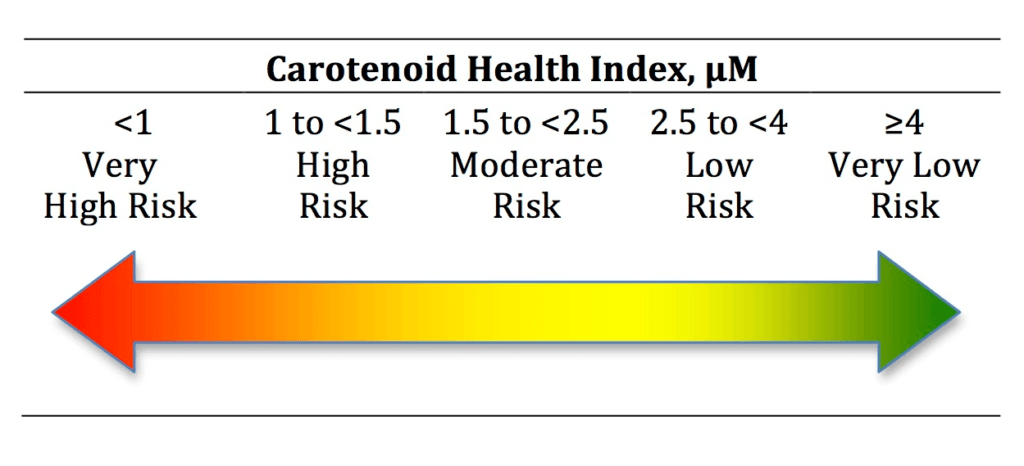
Here’s the number that should stop you. Over 95 percent of the US population falls into the moderate or high-risk category. Almost nobody is even getting close to the low or very low risk zones, the ranges where the strongest protection against metabolic syndrome and cancer actually shows up.
There’s a pattern worth understanding here too. For all-cause mortality, protection seemed to kick in above even the lowest cutoff, more of a threshold effect. But for metabolic syndrome and cancer outcomes, meaningful protection generally only showed up at the higher cutoff points. I think there may be a triage effect at work, a concept Bruce Ames proposed for other micronutrients: the body may direct scarce carotenoids to the systems most critical for short-term survival first, and only send the surplus to the slower, subtler processes that prevent cancer and metabolic disease over the long run. If that’s right, it means a low intake might be enough to avoid dying tomorrow, but nowhere near enough to actually prevent the diseases that take decades to develop.
Carotenoid Concentrations in Long-Term Plant-Based Eaters
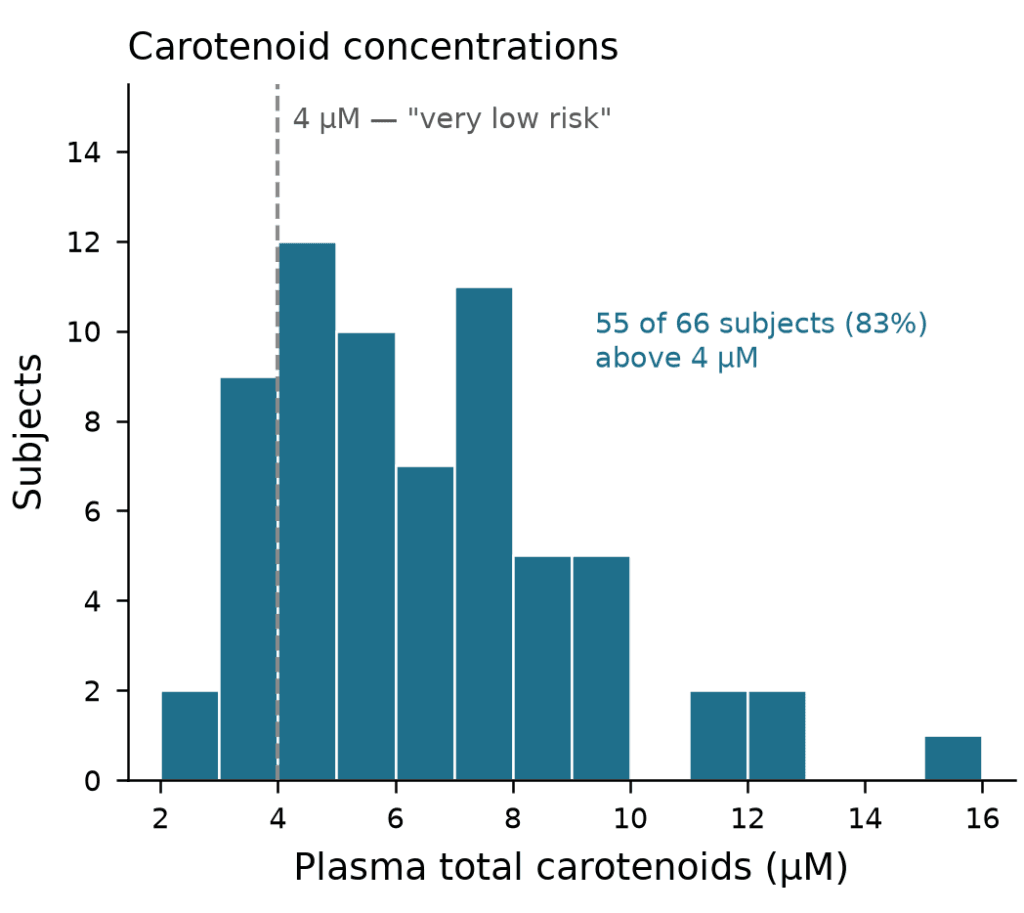
In 2012, after constructing the Carotenoid Health Index, I did a cross-sectional survey of 66 people who had followed a raw, whole-food, plant-based diet for years, with their permission, and checked their blood for carotenoid concentrations.
Here’s what I found from the unpublished results, shown in the figure below. Of the 66 people in the study, 55 of them had a total carotenoid concentration above 4 µM, putting them in the very lowest risk category of negative health outcomes. The carotenoid concentration correlated most strongly with vegetable juicing; not salads, not fruit, not a greens supplement, or anything else, but how often and how much vegetable juice they drank.
I
t’s important to note here that these carotenoid concentrations were not generated from a carotenoid supplement pill. They were from carrot/vegetable juice. In fact, beta-carotene supplements have not been shown to be generally helpful, and they actually increase lung cancer risk in smokers.
The takeaway message from this data is to eat a wide variety of antioxidant- and carotenoid-rich foods, and to get a large amount of produce into your body by using vegetable juicing or blended salads. Carrot/vegetable juice is how the people in my survey did it. I think it would be very hard to get these high levels of carotenoids without consuming carrots, yams, squash, or something like those foods that are high in carotenoids on a daily basis.
Why This Doesn’t Feel Like a Chore
Nobody in that survey was counting servings of fruits and vegetables. They were following a pattern. When your plate is built around raw fruits, vegetables, vegetable juice, whole grains, nuts, and seeds (with processed food, meat, and dairy set aside), high produce intake just happens. It’s a byproduct of how you eat, not a number you have to remember.
So How Many Fruits and Vegetables Should You Eat?
The people in my carotenoid biomarker study were eating about 6 ervings of fruits and 11 servings of vegetables a day. The Wahls Diet, another nutrient-dense diet, recommends over 650 g of fruits and almost 800 g of vegetables per 2,000 calories. A recent diet analysis I did also came up with very similar amounts: around 1.5 pounds of fruit a day and 2 pounds of vegetables as optimal amounts.
There’s lots of ways to define servings of fruits and vegetables, but I don’t think that’s the main point.
Just weigh it out and get an idea of how much fruit you’re eating each day by weight, and how many pounds of vegetables you get every day.
An 8-ounce glass of vegetable juice is half a pound right there. A green smoothie might have another ½ pound of vegetables in it, depending on what you throw in your blender.
A big dinner salad with several vegetables in it could be 12 to 16 ounces, almost another pound. Cooked vegetables count as well. If you can follow a simple whole-food eating pattern, it isn’t hard to get 1.5 pounds of fruit and nearly 2 pounds of vegetables. You will have to work a bit to get to 2 pounds, but planning it out helps.
Common Questions
Is 10 servings of fruits and vegetables a day too much?
No, and the evidence for a hard ceiling is weaker than most articles let on. The studies that suggest benefits flatten out around 5 to 10 servings mostly come from populations that don’t eat very much produce to begin with, which makes it hard to trust their upper bound. Populations that eat more and biomarker-based research using blood carotenoid levels both suggest the real protective range may sit higher than the standard American guidelines assume. If you have a specific digestive condition, a kidney concern, or you’re on blood thinners, talk with your own healthcare provider, since certain vegetables interact with certain medications.
Can you eat too many vegetables?
It’s possible to overdo it in specific situations. Fast increases in fiber intake can cause temporary bloating or gas, especially if your gut isn’t used to it yet. The fix is usually pace, not restriction. Just ramp up a bit slower. Drinking a lot of carrot juice can turn your skin a bit orange, which is quite harmless. You can back off just a bit if this happens to you.
Why do studies disagree on the ideal number?
Mostly because of who got studied. Large American cohorts eat relatively little produce to start with, so estimates of where the benefit tops out are only as good as the range of intake actually observed in that group. A 2025 study of nearly 67,000 people in Spain, a country with a much higher baseline intake, directly tested the 5-serving ceiling and found protection continuing up to 10 servings a day, especially from vegetables. England’s data shows the same pattern. Studies measuring blood carotenoids directly instead of relying on food diaries point the same direction. The true optimum is higher than 5 servings.
Here’s a Food Pattern That Works.
Start the day with a green juice or a greens powder drink. It’s an easy way to bank concentrated nutrition before you’ve eaten a single meal. It’s not a workaround; it’s part of eating well.
Make salad the main course, not the side. A large dinner salad with several vegetables can supply almost half of your vegetables for the day.
Eat more vegetables than fruit. Across the Spain and England data, fruit’s benefit tends to level off earlier while vegetables keep paying off at higher intakes. If you’re only going to add one more serving today, make it a vegetable.
Eat the colors, not just the volume. Protective phytonutrients vary across different-colored vegetables, and they work together to provide you with multi-faceted protection.
Drink one or two glasses of carrot/vegetable juice a day. If you’re facing any kind of health challenge and want to get a nutrition “home run,” this is it. It is an effort to make it on an every-other-day basis, but it’s very easy to consume, and the rewards are worth it.
Snack on raw produce instead of packaged food. Carrot sticks, apple slices, and bell pepper strips travel well and need zero prep.
Want this pattern somewhere you’ll actually see it, like your fridge or your kitchen wall, instead of buried in a browser tab? Enter your email below and I’ll send you the free one-page printable version: the real number, the research, and the checklist, all on a single page you can print and keep.
TWHP Perspective
Our value statement here at TWHP is, “Love truth, pursue health, enjoy people, build wealth.” First off, you need to love truth. When we ask the question, “How many fruits and vegetables should we eat?” it’s not a relative answer. There’s actually a real answer, an objective truth.
It can’t be the expert’s fuzzy answer, “I think this is the answer they want to hear,” Our bodies run on objective biology. It’s not just subjective, “your truth is your truth” and “my truth is my truth.” Biology isn’t like that.
So you need to love truth first. Based on data from two different surveys of people who’ve eaten a whole-food, plant-based diet for years, the practical answer comes out to about 700 grams of fruit and 1,000 grams of vegetables a day for a 2,000-calorie diet. In pounds, that’s roughly a pound and a half of fruit and two pounds of vegetables.
There is the clear answer, and you can mull over it and decide how close you can get to that target from where you are right now. And remember, you don’t have to do everything all at once. You make one change at a time. Make that change into a habit, and then build on that habit. Stack those small habits until you have a lifestyle change that’s impactful and makes a huge difference. That’s pursuing health.
What will you do with the higher level of health that you achieve? I’m sure you have ideas. They probably fall along the lines of enjoying people and building wealth. Spend time with those you love. Be creative. Leave the world a better place and enjoy people along the way. That’s what we’re all about here.
If you want a conversation about how to improve your diet and feel healthy again, head on over to my coaching page and book a call. I’d love to talk with you.
References
Donaldson, M.S. (2011). A carotenoid health index based on plasma carotenoids and health outcomes. Nutrients, 3(12), 1003–1022. https://doi.org/10.3390/nu3121003. PMID: 22254093.
Khaw, K.T., Bingham, S., Welch, A., Luben, R., Wareham, N., Oakes, S., & Day, N. (2001). Relation between plasma ascorbic acid and mortality in men and women in EPIC-Norfolk prospective study: a prospective population study. Lancet, 357(9257), 657–663. https://doi.org/10.1016/S0140-6736(00)04128-3. PMID: 11247548.
Martínez-Castañeiras, P., Ortiz, C., Fernandez de Larrea-Baz, N., Lope, V., Sánchez-Gordón, G., Ruiz-Moreno, E., Alonso, I., Garcia-Esquinas, E., Pérez-Gómez, B., Pastor-Barriuso, R., Galán, I., & Castelló, A. (2025). Intake of fruit, vegetables and pulses, and all-cause, cardiovascular and cancer mortality: Results from a population-based prospective study. Public Health, 239, 169–178. https://doi.org/10.1016/j.puhe.2024.12.014.
Oyebode, O., Gordon-Dseagu, V., Walker, A., & Mindell, J.S. (2014). Fruit and vegetable consumption and all-cause, cancer and CVD mortality: analysis of Health Survey for England data. Journal of Epidemiology and Community Health, 68(9), 856–862. https://doi.org/10.1136/jech-2013-203500. PMID: 24687909.
Satija, A., Bhupathiraju, S.N., Spiegelman, D., Chiuve, S.E., Manson, J.E., Willett, W.C., Rexrode, K.M., Rimm, E.B., & Hu, F.B. (2017). Healthful and unhealthful plant-based diets and the risk of coronary heart disease in U.S. adults. Journal of the American College of Cardiology, 70(4), 411–422. https://doi.org/10.1016/j.jacc.2017.05.047.
Hu, F.B., Manson, J.E., Stampfer, M.J., Colditz, G., Liu, S., Solomon, C.G., & Willett, W.C. (2001). Diet, lifestyle, and the risk of type 2 diabetes mellitus in women. New England Journal of Medicine, 345(11), 790–797. https://doi.org/10.1056/NEJMoa010492.
Stampfer, M.J., Hu, F.B., Manson, J.E., Rimm, E.B., & Willett, W.C. (2000). Primary prevention of coronary heart disease in women through diet and lifestyle. New England Journal of Medicine, 343(1), 16–22. https://doi.org/10.1056/NEJM200007063430103.
Platz, E.A., Willett, W.C., Colditz, G.A., Rimm, E.B., Spiegelman, D., & Giovannucci, E. (2000). Proportion of colon cancer risk that might be preventable in a cohort of middle-aged US men. Cancer Causes & Control, 11(6), 579–588. https://doi.org/10.1023/A:1008999232442.
Mozaffarian, D., Kamineni, A., Carnethon, M., Djousse, L., Mukamal, K.J., & Siscovick, D. (2009). Lifestyle risk factors and new-onset diabetes mellitus in older adults: the Cardiovascular Health Study. Archives of Internal Medicine, 169(8), 798–807. https://doi.org/10.1001/archinternmed.2009.21.