
Key Takeaways
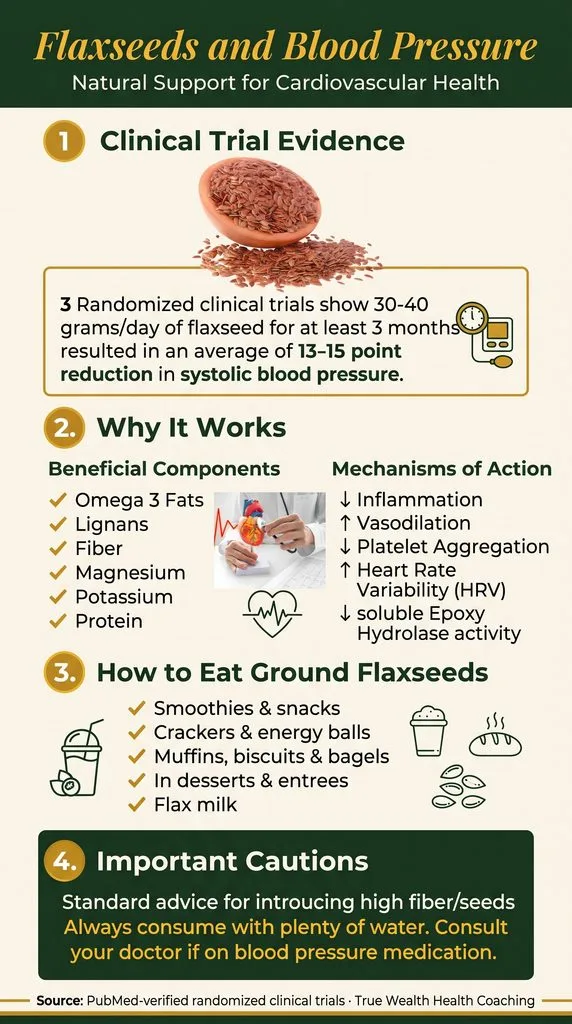
- Two randomized clinical trials found that 30 grams (about 1/4 cup) of ground flaxseed a day lowered systolic blood pressure by 13 to 15 points in people with high blood pressure.
- In the larger trial, the effect showed up mostly in people who started with high blood pressure (140 or above).
- Flax lignans, taken alone as a supplement, also lowered systolic blood pressure in older adults who started with high readings, which suggests they play a part in flax’s effect.
- Flax works through several routes at once: omega-3 fat, lignans, fiber, and magnesium. No single nutrient does the job alone.
- Some populations eat and live in ways that keep blood pressure normal into old age, which tells us high blood pressure is not just a part of aging.
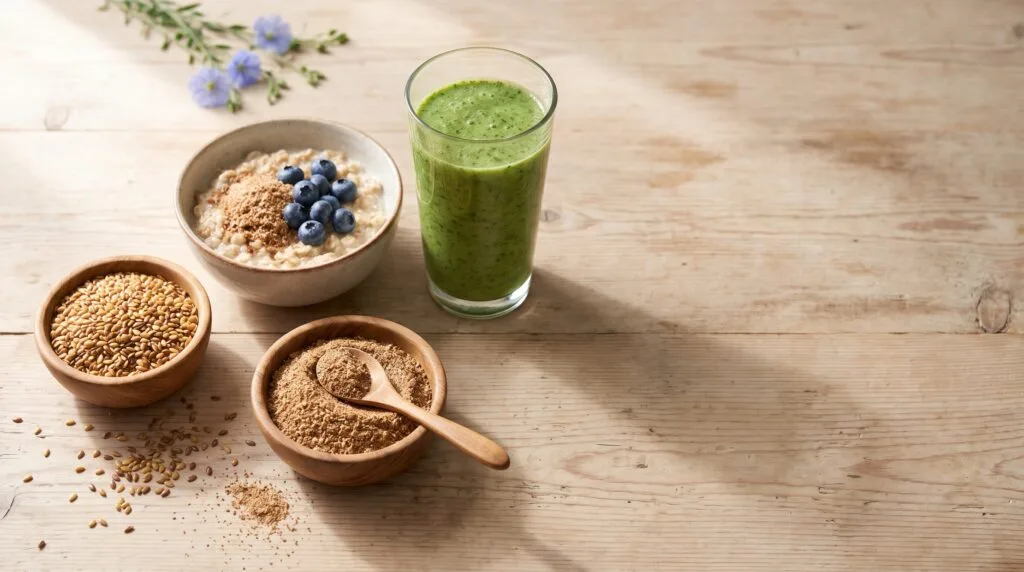
- Ground flax is easy to add to oatmeal, smoothies, baked goods, and crackers. Whole seeds mostly pass through you unused.
Why Blood Pressure Matters
You can’t feel your blood pressure, so high blood pressure is often called the “silent killer.” Many people only find out they have it at a routine checkup, or after a stroke. Worldwide, about 1.3 billion people have hypertension, and it is one of the leading risk factors for early death.
Most people assume blood pressure just creeps up as we age. That’s true in the modern West. It isn’t true everywhere.
Diet, Not Just Age, Drives Blood Pressure
A 1929 survey of men from four tribes in Kenya found that blood pressure did not rise with age. Even men over 60 averaged about 106/67. European men in the same comparison commonly had readings of 140/90 or higher.
A more recent example comes from the Tsimane, forager-farmers in Bolivia. Researchers followed 2,248 adults for eight years. Only 3.9% of women and 5.2% of men had hypertension, and blood pressure rose far more slowly with age than it does in industrialized countries. The authors pointed to the Tsimane’s lean build, active lifestyle, and protective diet (Gurven et al., 2012).
In other words, high blood pressure looks like a disease of how we live. You don’t have to give up modern life to change it. Some foods, like flaxseed, can make a real difference with small changes.
What’s in Flaxseed?
Flaxseeds are small, but they carry a lot. A 30-gram serving (about 1/4 cup) has roughly:
- 6 g protein
- 13 g fat, including 7.2 g of ALA, a plant-based omega-3
- 8.6 g fiber
- 123 mg magnesium
- 256 mg potassium
Most Americans fall short on fiber, magnesium, potassium, and omega-3 fats. Flax helps fill all four gaps.
Flax also has benefits beyond blood pressure. Its fiber feeds your gut and slows sugar absorption, which helps with blood sugar control and feeling full. The omega-3 fat supports your heart and brain. Flax lignans have also drawn interest for cancer research, though that work is still early.
How Flaxseed May Lower Blood Pressure
Researchers think flax works through several paths at once:
- Omega-3 fat (ALA). Omega-3 fats calm inflammation in the lining of blood vessels, help vessels relax by boosting nitric oxide, and make blood less sticky. ALA is also converted in the body to EPA, an omega-3 with these effects. ALA may also block an enzyme (soluble epoxide hydrolase) that breaks down helpful fats that relax blood vessels.
- Lignans. These plant compounds are found in flax in high amounts. In a six-month trial of adults ages 60 to 80, a once-daily flaxseed lignan supplement lowered systolic pressure in people who started with high readings (Di et al., 2017). Because the supplement contained lignans but no flax oil or fiber, lignans appear to have an effect of their own, separate from omega-3 fat and fiber.
- Magnesium. This mineral helps blood vessels relax, and most of us don’t get enough.
- Fiber. It supports gut health and weight control, both tied to blood pressure.
What about the arginine in flax? Arginine helps make nitric oxide, but a serving of flax has only 500 to 700 mg, which probably isn’t enough on its own to matter. The benefit seems to come from the whole package working together.
What the Clinical Trials Found
The FLAX-PAD trial (2013). Rodriguez-Leyva and colleagues ran a double-blind, placebo-controlled trial in 110 people with peripheral artery disease. Half ate foods like bagels, muffins, and pasta made with 30 g of milled flaxseed every day for six months. The other half ate look-alike foods without flax. Overall, systolic pressure was about 10 points lower and diastolic about 7 points lower in the flax group. For people who started with a systolic pressure of 140 or higher, the drop was 15 points systolic and 7 points diastolic. The authors called it one of the most potent blood pressure effects seen from a dietary change.
The Iranian trial (2021). Toulabi and colleagues randomized 112 people with hypertension, ages 35 to 70, to 30 g of flaxseed, 10 g of flaxseed, or placebo for 12 weeks. In the 30 g group, systolic pressure fell by 13.4 points, while the placebo group’s rose by 1.7. Diastolic pressure fell by 5.6 points in the flax group. Total cholesterol and BMI also improved. One caution: the groups started at somewhat different blood pressures, so the results are best read as encouraging rather than final.
The lignan trial (2017). Di and colleagues at the University of Saskatchewan gave older adults (ages 60 to 80) either a flaxseed lignan supplement (600 mg of SDG, the main flax lignan) or a placebo once a day for six months. The trial was designed mainly to study inflammation, and most of its measures didn’t change. But among participants who started with a systolic pressure of 140 or higher, systolic pressure in the lignan group fell from an average of 155 to 140. No side effects were reported. This was a small trial, and the blood pressure result came from a subgroup, so it’s a promising lead rather than proof. It does fit the pattern from the two flaxseed trials: the benefit showed up in people whose blood pressure started out high.
Put together, these trials suggest a drop of about 13 to 15 points in systolic pressure is possible for people with high blood pressure who eat 30 g of ground flax daily for at least 12 weeks. The lignan trial points the same direction. Results vary from person to person.
Easy Ways to Eat More Flax
- Grind it. Whole seeds often pass through undigested. Ground flax is the form used in the trials.
- Stir it into oatmeal or other hot cereal.
- Blend it into smoothies. Up to 2 tablespoons barely changes the taste or thickness.
- Bake with it. Muffins, bagels, and biscuits worked in the FLAX-PAD trial. Normal baking temperatures (around 200°F inside the food) didn’t ruin the omega-3 oil.
- Make flax crackers in a dehydrator or a low oven.
- Sprinkle it on salads, soups, and yogurt alternatives.
Start with a tablespoon a day and work up to about 1/4 cup, and drink plenty of water as you increase your fiber.
A Few Cautions
Fiber can slow how your body absorbs some medications. Ask your doctor or pharmacist whether you should space flax away from your medicines. If you take blood pressure medication, talk with your healthcare provider before making changes, since your numbers may improve and your doses may need adjusting. This article is for education only and does not replace medical advice.
Get the Free Flaxseed and Blood Pressure Infographic
Want a quick reference you can keep on your fridge? Download our free infographic with the key numbers, the daily serving size, and easy flax ideas. Enter your email below and we’ll send it right over.
References
- Rodriguez-Leyva D, Weighell W, Edel AL, et al. Potent antihypertensive action of dietary flaxseed in hypertensive patients. Hypertension. 2013;62(6):1081-1089. doi:10.1161/HYPERTENSIONAHA.113.02094
- Toulabi T, Yarahmadi M, Goudarzi F, et al. Effects of flaxseed on blood pressure, body mass index, and total cholesterol in hypertensive patients: a randomized clinical trial. Explore (NY). 2021;18(4):438-445. doi:10.1016/j.explore.2021.05.003
- Di Y, Jones J, Mansell K, et al. Influence of flaxseed lignan supplementation to older adults on biochemical and functional outcome measures of inflammation. J Am Coll Nutr. 2017;36(8):646-653. doi:10.1080/07315724.2017.1342213
- Gurven M, Blackwell AD, Rodríguez DE, Stieglitz J, Kaplan H. Does blood pressure inevitably rise with age? Longitudinal evidence among forager-horticulturalists. Hypertension. 2012;60(1):25-33. doi:10.1161/HYPERTENSIONAHA.111.189100