

We live in an age of “better living through chemistry.” In many ways, that’s true. Plastics work better than they used to. Technology saves us hard physical labor. Getting food, clothes, and shelter takes far less work than it did for our great-grandparents. Nobody wants to give up those gains. But are we paying a price we don’t yet understand?
What if the type 2 diabetes epidemic isn’t only about overeating and sitting too much? What if part of the huge rise in diabetes comes from the chemicals in our environment, the ones that end up inside our bodies?
Dr. Joseph Pizzorno, ND, asked that question in a 2016 editorial, “Is the Diabetes Epidemic Primarily Due to Toxins?” in Integrative Medicine: A Clinician’s Journal. He looked at the data and argued that much of the rise in diabetes since the 1960s tracks the rise in the chemicals we make. He’s worth hearing out. Pizzorno co-wrote the Textbook of Natural Medicine with Michael Murray, ND, and co-founded Bastyr University, which became the first accredited naturopathic medical school in the U.S. Let’s take a closer look at what he found, and at what the research does and doesn’t prove.
How Fast Has Type 2 Diabetes Grown?
Diabetes was once rare. In the 1935 to 1936 National Health Survey, roughly 3 in 1,000 Americans, or 0.3%, had known diabetes. By 1957 to 1959, the survey estimated 9 in 1,000, or 0.9%, according to a 1960 report from the CDC’s National Center for Health Statistics. By 2015, the CDC reported that 7.2% of the U.S. population had diagnosed diabetes.
It has kept climbing. The CDC estimates that 14.9% of U.S. adults had diabetes in 2021 to 2023, about 15 in 100. That count includes people who haven’t been diagnosed yet. Among adults 45 to 64, the rate was 20.6%, about 1 in 5. Among adults 65 and older, it was 28.8%. Compared with the early surveys, that’s nearly 17 times the 1957 to 1959 rate and about 50 times the 1935 to 1936 rate. The comparison isn’t perfectly even, since the early surveys counted only known cases in people of all ages. Still, it’s a huge jump.
Part of that rise is real, and part reflects better testing, an older population, and people living longer with the disease. Still, our genes haven’t changed much in 60 years. Something in our surroundings has. The question is what.
Does Sugar Explain the Rise in Type 2 Diabetes?
Only in part. In his 2016 editiorial, Dr. Pizzorno argued that sugar intake doesn’t track diabetes very closely. In the graph he shows, U.S. sugar intake held fairly steady, at roughly 65 to 85 pounds per person per year, from the 1920s through the 1960s. Diabetes affected about 1% of people around 1950. From 1950 to 2005, sugar intake rose by roughly a third, while diabetes rates rose several times over.
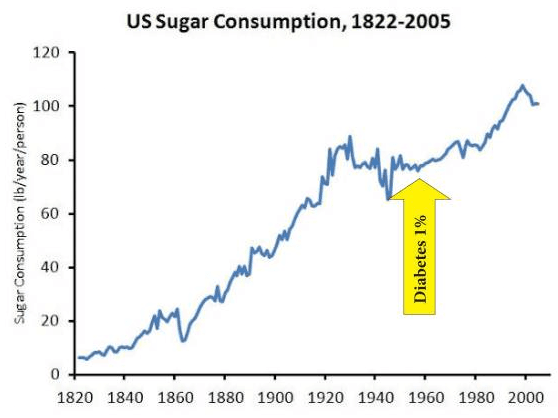
Source: Pizzorno, 2016.
That doesn’t mean sugar is harmless. Sugar, extra body fat, and inactivity all raise risk. His point is that they may not tell the whole story.
What Do Chemicals Have to Do With It?
The timelines line up. Pizzorno shows a second graph that lines up U.S. diabetes rates with yearly production of synthetic organic chemicals, which include plastics, solvents, pesticides, and fuels. Production climbed from near zero in 1940 to about 270 billion kilograms by 2007. Diagnosed diabetes rose from under 1% in 1958 to about 6% by 2008, and the two lines track each other closely. Some of these chemicals are persistent organic pollutants, or POPs. They don’t break down easily, so they build up in our bodies over time.
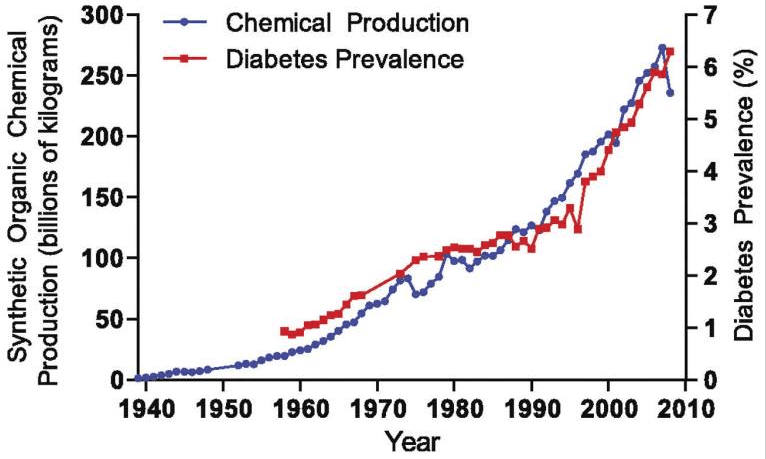
Source: Pizzorno, 2016.
Here’s the catch. This isn’t proof that one causes the other, but the correlation is an interesting hypothesis. Plenty of other things changed in the same years, including processed foods and seed oils. A matching graph is a great starting point.
Pizzorno also made rough estimates of how much each chemical might contribute to diabetes. The biggest were phthalates (22%), arsenic (18%), and PAHs (16%), which are chemicals made when things burn. BPA, PCBs, dioxins, and certain pesticides made up the rest. On paper they total 90%.
That 90% number is just an estimate of how these chemicals contribute to diabetes. just as Dr. Pizzorno stated. These chemicals overlap. People with a lot of one toxin often carry a lot of others, so the pieces can’t simply be added up. It isn’t clear to me exactly how he came up with these numbers.
Pizzorno also reports that obese people with low POP levels didn’t show higher diabetes risk. If that holds up, it would suggest toxins could be a trigger. Only about one in five obese people has diabetes, so it’s not a one-to-one correlation at all. This idea should be examined more closely, and it has been since he wrote in 2016.
How Could Chemicals Affect Blood Sugar?
By lowering insulin made or insulin used. Insulin is the hormone that moves sugar from your blood into your cells. A 2018 review in Current Opinion in Toxicology by Marcelo Bonini and Robert Sargis explains how arsenic stresses the energy factories (mitochondria) inside beta cells. Beta cells are the pancreas cells that release insulin. That stress can make them release less of it. The review also cites a meta-analysis that linked arsenic to a 71% higher diabetes risk.
Other chemicals, including BPA and phthalates, are thought to make cells respond less to insulin. A 2023 review in Exposure and Health by Jian-Yan Lin and Rui-Xing Yin reports that early-life exposure to endocrine-disrupting chemicals has been linked to type 2 diabetes later in life, in both human and animal studies.
What Else Does the Research Show?
Several lines of evidence point in the same direction, but most of it is observational.
- Cadmium. Cadmium is a heavy metal. It comes mostly from food grown in contaminated soil, tobacco smoke, and some jobs. A 2022 meta-analysis of 42 studies in Environment International by Tommaso Filippini and colleagues found a higher diabetes risk with the highest cadmium levels: about 21% higher by urine tests and 47% higher by toenail tests. The authors rated the certainty as moderate.
- Air pollution. A 2024 time-series study in Frontiers in Endocrinology by Zhuomin Hou and colleagues followed 13,797 people with type 2 diabetes in Xinxiang, China. On days with more carbon monoxide, fine particles, nitrogen dioxide, and ozone, more people were admitted to the hospital for diabetes. Carbon monoxide was also tied to longer stays. This shows pollution is tied to hospital visits in people who already have diabetes. It doesn’t show that pollution causes new cases; it makes it worse if you already have diabetes.
What Doesn’t the Research Prove?
That chemicals cause type 2 diabetes. Many studies measure exposure once and look at disease years later. People are exposed to dozens of chemicals at the same time. Pizzorno’s piece is an editorial, not a clinical trial.
Utilizing detoxification regimens for reversing type 2 diabetes is a popular idea on the internet. However, there isn’t published proof that it actually works. No one has proven reversal of diabetes by detoxification alone.
However, drinking plenty of water, eating high-fiber foods, and eating cruciferous vegetables all help with detoxification. A whole-foods plant-based diet is an excellent way to do this. This method is slow, quite painless, and ongoing. Losing weight helps with detoxification. As you lose the fat that stores the chemicals, both of them go away: the fat and the chemicals. I’ll discuss that more in the next article on diabetes detoxication methods that actually work.
What Should You Do With This Information?
The principal way to reverse diabetes is to lose weight. I discuss that in another article, laying out the facts for why weight loss is the primary means for reversing type 2 diabetes. Eliminating toxins is a part of that process, but it’s not the main thing.
If your blood sugar isn’t responding as you’d expect, metabolic lab testing can reveal what’s going on beneath the surface. Our health coaching can help you act on the results. Learn more about testing and coaching here: https://twhealthproducts.com/true-wealth-health-coaching/
Frequently Asked Questions
Do toxins cause type 2 diabetes? Studies link several chemicals, including arsenic, cadmium, and BPA, to higher diabetes risk. That’s an association. Cause and effect hasn’t been proven.
Is sugar still a risk for type 2 diabetes? Yes. Sugar, body fat, and inactivity all raise risk. Chemicals may be an added factor, not a replacement.
Can you remove toxins from your body to reverse diabetes? Nobody has shown that yet. Lowering your exposure is a reasonable step. It shouldn’t replace your diet, activity, or your doctor’s care.