

Key Takeaways
- Melatonin doesn’t have a single, fixed effect on blood sugar. Its impact depends heavily on when it’s elevated relative to when you eat.
- A 10 mg nightly dose reduced insulin sensitivity by 12% in men with type 2 diabetes over three months in one randomized trial. A 2 mg dose showed no significant effect on insulin resistance in another.
- People who naturally produce less melatonin at night appear to have a higher long-term risk of developing type 2 diabetes, the opposite direction from the supplement studies.
- The mechanism: melatonin binds to receptors on pancreatic beta cells and can suppress insulin release, particularly when it’s circulating at the same time you’re digesting a meal.
- Separating melatonin intake from food by at least two hours may reduce this risk. This matters for everyone, but especially for people with diabetes or prediabetes.
- Melatonin does decline with age, but the popular claim that it “crashes” starting at age 40 doesn’t match the data. The real drop is concentrated much later in life.
Millions of People Take This Hormone Every Night. Almost Nobody Asks This Question.
An estimated 3 million American adults reach for melatonin most nights of the month, mostly for sleep, mostly without a prescription. It sits on drugstore shelves next to vitamins, treated as harmless as a glass of warm milk.
But melatonin isn’t just a sleep hormone. It’s also a metabolic signal your pancreas is listening to. And the research on what it does to your blood sugar is more interesting, more contradictory, and more useful than most headlines let on.
If you’ve searched this question yourself, you’ve probably found conflicting answers. Some articles say melatonin raises blood sugar. Others say low melatonin is what’s dangerous. Both are backed by real studies. Both are, in a sense, correct. The key is understanding why.
Why Does This Question Even Have Two Different Answers?
Here’s the tension. On the one hand, researchers have found that low endogenous (naturally produced) melatonin is linked to a higher risk of diabetes. On the other hand, clinical trials administering melatonin supplements have sometimes found the opposite: they can worsen insulin sensitivity.
These aren’t contradictory studies arguing over the same thing. They’re describing two entirely different situations. The first is about your body’s own nighttime melatonin rhythm over years. The second concerns what happens acutely when melatonin is artificially elevated at the wrong time. Once you separate these, the confusion mostly disappears.
The Mechanism: How Melatonin Talks to Your Pancreas
Melatonin doesn’t just act on your brain’s sleep centers. It also binds to receptors called MT2, found directly on the beta cells of your pancreas, the same cells that release insulin.
When melatonin binds there, it triggers the release of somatostatin, a hormone that inhibits insulin secretion. This isn’t a side effect or a fluke. It’s a built-in part of how melatonin works. A study published in Trends in Endocrinology & Metabolism by Garaulet and colleagues at Brigham and Women’s Hospital and Harvard Medical School lays this out clearly: melatonin administration stimulates secretion of somatostatin in human pancreatic islets, directly dialing back insulin release.
So melatonin suppresses insulin. Full stop. The question that actually matters is: does that suppression happen at a moment when your body needs insulin, or a moment when it doesn’t?
The Timing Model: Why the Same Hormone Can Help or Hurt
This is where the Garaulet review gets genuinely useful. The researchers propose what they call a “Timing Model” to reconcile years of conflicting melatonin research. The core idea is simple once you see it:
Melatonin suppressing insulin at night, while you’re fasting and asleep, is protective. It gives your beta cells a rest period, much like muscles need rest between workouts. The researchers describe this as facilitating “β-cell recovery.”
Melatonin suppressing insulin while food is actively in your system is a problem. If melatonin is elevated at the same time glucose from a meal is entering your bloodstream, your pancreas can’t respond the way it should. Blood sugar runs higher and longer than it otherwise would.
The danger windows, according to this model, are late-night eating, exogenous melatonin taken too close to a meal, and shift work that forces eating during hours when melatonin is naturally elevated. All three put food and melatonin in at the same time, working against each other.
What the Clinical Trials Actually Found
Theory is one thing. Here’s what happened when researchers actually tested this in people.
High-dose melatonin worsened insulin sensitivity in people with type 2 diabetes. In a randomized, placebo-controlled crossover trial published in the Journal of Pineal Research, Lauritzen and colleagues at Aarhus University gave 17 men with type 2 diabetes 10 mg of melatonin nightly for three months. Insulin sensitivity dropped by about 12% compared to placebo. The researchers were direct about the implication: clinical use of melatonin at this dose should be reserved for situations in which the benefits clearly outweigh this metabolic trade-off.
Lower-dose melatonin showed no significant effect. A separate randomized, placebo-controlled trial published in Pharmacological Research tested a much lower dose (2 mg of sustained-release melatonin) in 24 rotating night shift workers over 12 weeks. This time, insulin resistance didn’t change significantly. Sleep quality improved, but the metabolic effect observed at the higher dose was not observed here.
Notice what’s different between these two trials: not just the population, but the dose. 10 mg versus 2 mg is a five-fold difference, and the results diverge accordingly. Dose likely matters here nearly as much as timing.
Low natural melatonin is linked to a higher diabetes risk over time. This is the piece that seems to contradict the above, until you remember it’s measuring something different. In a case-control study nested within the Nurses’ Health Study, published in JAMA, McMullan and colleagues followed 370 women who developed type 2 diabetes and matched them against 370 controls. Women with the lowest natural nighttime melatonin secretion had roughly double the risk of developing diabetes compared to women with the highest secretion.
This isn’t about taking a supplement. It’s about your body’s own rhythm, measured over years, in people who weren’t taking melatonin at all. A strong nighttime melatonin rhythm seems to go along with better long-term metabolic health, and it may even help protect it. That’s a different question from what happens if you take 10 mg tonight.
Busting the Myth: Does Melatonin “Crash” at Age 40?
This claim shows up constantly in wellness content, usually with a dramatic number attached. The direction is accurate. Melatonin genuinely does decline with age, and the researchers most associated with melatonin science, including Russel Reiter at UT Health San Antonio, have said so directly. In a 2023 review in Cellular and Molecular Life Sciences, Reiter and colleagues report that melatonin levels drop dramatically in the frail aged, linking this decline to reduced clearance of neurotoxins from the brain and an increased risk of dementia.
But notice the language: “frail aged.” Not “forty-year-olds.” Not “midlife.”
This gets confirmed with hard numbers in a classic study published in the Journal of Clinical Endocrinology & Metabolism. Waldhauser and colleagues measured nighttime melatonin in 367 people ranging in age from 3 days to 90 years. The pattern they found surprised us:
Melatonin levels do fall dramatically, but that decline occurs during childhood and adolescence, not in midlife. Levels peak around ages 1–3, then drop by roughly 80% by ages 15–20, tracking almost perfectly with increasing body size during growth.
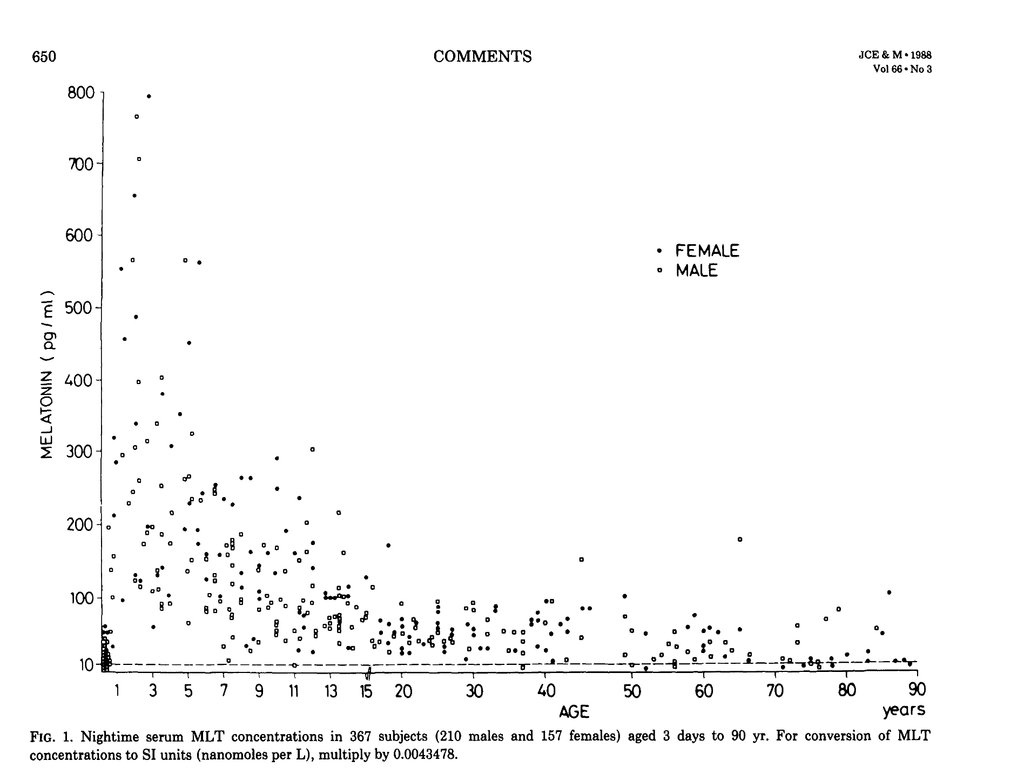
Decline in melatonin with aging. From Waldhauser et al. 1988.
From young adulthood on, the picture looks nothing like “declining at 40.” The researchers compared four adult age groups: 20–35, 35–50, 50–70, and 70–90. Levels stayed statistically flat across the first three groups. The only group that showed a significant drop was the 70–90-year-old group. See the Figure above.
So both things are true at once. Melatonin does decline with age, exactly as Reiter and other melatonin researchers have said. But the timing of that decline isn’t what the popular version claims. It isn’t a midlife cliff. It’s a gradual, mostly stable plateau through most of adulthood, followed by a real drop concentrated in advanced age.
How to Use Melatonin Without Working Against Your Blood Sugar
Given everything above, the practical guidance writes itself, and it comes straight from the researchers who built the Timing Model.
Separate melatonin from food by at least two hours. This is the direct recommendation from the Garaulet review for people using exogenous melatonin, especially those managing type 2 diabetes. If you take a melatonin supplement, don’t pair it with a late dinner or a bedtime snack.
Move dinner earlier if you can. Eating while your endogenous melatonin is naturally rising creates the same conflict as taking a supplement too close to food.
Be thoughtful about breakfast timing too. Morning melatonin hasn’t always fully cleared by the time some people wake up and eat. The researchers suggest that pushing breakfast slightly later, rather than eating the instant you wake, may help avoid this overlap.
If you take melatonin and have diabetes or prediabetes, the dose matters. The 10 mg trial showed a real effect. The 2 mg trial didn’t. If sleep is the goal, the lowest effective dose is worth discussing with your doctor, not just for melatonin’s sake, but for your blood sugar’s sake too.
None of this applies only to diabetics. Insulin resistance builds gradually in nearly everyone over time, often silently. The habit of separating melatonin from food and eating earlier in the evening is protective groundwork for anyone paying attention to their metabolic health, not just people with a diagnosis.
Frequently Asked Questions
Does melatonin raise blood sugar?
It can, but only under specific conditions. High-dose melatonin taken close to food, especially in people who already have insulin resistance or type 2 diabetes, has been shown to reduce insulin sensitivity in clinical trials. Lower doses have shown a smaller or negligible effect.
Can a diabetic take melatonin?
Many people with diabetes take melatonin without issue, but the trials above show dose and timing genuinely matter. Talking with your doctor about the lowest effective dose and taking it a couple of hours apart from meals is a reasonable approach based on those findings.
What is the best time to take melatonin for blood sugar?
Based on the Timing Model from melatonin researchers, taking it at least two hours away from any food intake appears to limit the overlap between elevated melatonin and a glucose load, which is the combination linked to worsened insulin sensitivity.
Is 10 mg of melatonin too much?
The one clinical trial that used this exact dose in people with type 2 diabetes found a meaningful drop in insulin sensitivity over three months. A lower dose (2 mg) in a different trial didn’t show this effect. If you’re taking melatonin regularly, a lower dose may be worth discussing with your healthcare provider. A dose as low as 0.3 mg gives you a physiological effect. 3 mg of melatonin is plenty for most people. 10 mg or more is used in studies to help with cancer.
Does melatonin decline with age?
Yes, but not the way it’s usually described. The dramatic decline happens in childhood and adolescence. Levels then remain relatively stable throughout most of adulthood, with the next significant drop occurring much later in life, around age 70 and beyond.
Where to Go From Here
Understanding how melatonin interacts with your metabolism is the first step. Building daily habits that support both good sleep and healthy blood sugar is next.
Our free guide, 10 Simple Ways to Support Healthy Metabolism, walks through practical, evidence-based steps you can start using tonight, including how to think about supplement timing alongside the rest of your routine.
If you’re managing a specific condition like prediabetes or type 2 diabetes and want personalized guidance on how sleep, supplements, and metabolic health fit together for your situation, that’s exactly the kind of thing we work through in True Wealth Health Coaching.