
That jar of curry powder in your cabinet isn’t just for flavor. A research team in Singapore examined its effects in people, one meal at a time, and found some genuinely interesting effects on appetite hormones and blood sugar.
Here’s the setup. Researchers made a spice blend of turmeric, coriander seed, cumin seed, amla (dried Indian gooseberry), cayenne, cinnamon, and clove, mixed at an 8:4:4:4:2:1:1 ratio. Healthy volunteers ate white rice with either 6 grams or 12 grams of this blend, or no spice at all as the control. Then researchers tracked what happened in their blood over the next few hours.
These Polyspice studies tell you some things, but you need to know that they’re just single-meal studies in healthy young men. They weren’t long-term weight-loss trials or studies of people managing diabetes. You can think of these trials as strong early evidence for a mechanism. There’s no guarantee that adding curry spice to your rice will help you lose weight. The mechanisms here do support that idea, but we don’t have solid evidence yet.
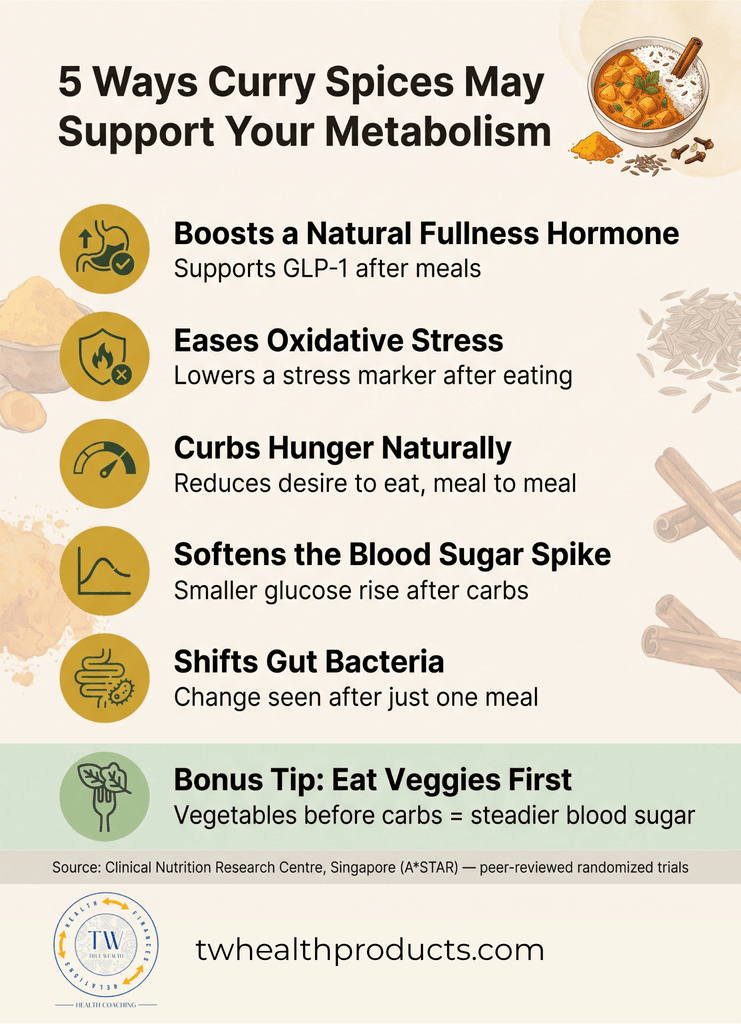
1. Your Spice Blend May Boost a Natural Fullness Hormone
Sumanto Haldar and colleagues at the Clinical Nutrition Research Centre in Singapore found that this curry spice blend increased postprandial GLP-1, a hormone your gut releases to tell your brain you’re full and to slow stomach emptying. The effect was dose-dependent: more spice, more GLP-1. GLP-1 is the same hormone that drugs like Ozempic target, so it’s worth paying attention to natural ways of supporting it (European Journal of Clinical Nutrition, 2018).
2. It May Ease Oxidative Stress After a Meal
The same research group tracked allantoin, a blood marker of oxidative stress, after volunteers ate the spiced meals. They found allantoin levels dropped in a dose-dependent way, suggesting the spice blend helped buffer the oxidative “hit” that follows a carb-heavy meal (Frontiers in Physiology, 2019). Reduced postprandial oxidative stress is an important piece of the metabolic health puzzle, especially if you’re eating meals with refined carbohydrates.
3. It May Turn Down Hunger, Independent of Ghrelin
In a follow-up trial, the same team found that both doses of the spice blend significantly reduced hunger and desire to eat compared to the unspiced control. Interestingly, this happened without any change in ghrelin, the hormone usually blamed for hunger pangs. That tells us the spices are working through an entirely different pathway (Foods, 2018).
4. It May Blunt the Blood Sugar Spike
Using continuous glucose monitoring, researchers found that both spice doses significantly reduced the three-hour glucose spike after the rice meal, by 19% with the lower dose and 32% with the higher dose. Insulin also trended lower, though that particular result didn’t reach statistical significance in this small trial (European Journal of Nutrition, 2019). Still, a clinically significant smaller glucose spike after a refined-carb meal is worth knowing about.
5. It May Shift Your Gut Bacteria, After Just One Meal
A related study from the same cohort found that a single spiced meal increased Bifidobacterium, a beneficial bacterial genus, and suppressed Bacteroides, compared to the unspiced control. This occurred after a single serving, suggesting your gut microbiome responds to spice intake faster than you might expect (Scientific Reports, 2021).
Bonus: Eat Your Vegetables First
A separate Singapore-based trial tested something simpler: the order you eat your food. When healthy adults ate vegetables first, followed by protein, then rice, they had a notably smaller glucose spike and a stronger GLP-1 response than when rice came first (Clinical Nutrition, 2019).
This lines up with something we’ve always done in our house: starting meals with “fresh food,” an age-appropriate serving of raw fruit, raw vegetables, vegetable juice, or a green smoothie, before anything else hits the table. It’s a simple habit, and the research backs it up.
Practical Takeaways
- Season generously. The doses used in these trials (6–12 grams, roughly 1–2 teaspoons) are well within normal cooking amounts.
- Build your own blend. Turmeric, cumin, coriander, cinnamon, cayenne, and clove are all easy to find and easy to combine.
- Eat your vegetables first. Before you touch the rice or bread on your plate, start with something raw or lightly cooked.
- Think mechanism, not miracle. This research points to real, measurable shifts in appetite hormones and blood sugar after a single meal. Sustainable metabolic change still comes from what you eat, meal after meal, over time.
TWHP Perspective
Good research doesn’t need to be oversold to be worth your attention. This Spice Blend won’t undo a poor diet, but it’s a real low-cost tool that nudges your body’s own hunger and blood sugar signals in the right direction, one meal at a time. Spices are always a potent way to improve the quality of your diet. This is the kind of small step you can stack with other habits to make a big difference without changing much.
So, embrace truth and pursue health. This will give you more time and energy to enjoy the people in your life and build what you love to create.
Do you want more simple tips like this to improve your metabolism? Download our free guide and check it out. You’ll find some great tips that you can integrate into your diet and schedule today.
Check out 10 simple ways to support healthy metabolism.
Ready to see where your own metabolic markers stand? Reach out to schedule a metabolic lab testing consultation.