
Key Takeaways
- What it is: Sleeping with your head higher than your feet. Journals call it head of bed elevation.
- Best evidence: Trials support it for nighttime acid reflux, snoring, and mild to moderate sleep apnea.
- Reflux: In a crossover trial of 39 GERD patients, 69% got symptom relief with an 8-inch raise, versus 33% sleeping flat.
- Sleep apnea: A 7.5 degree tilt cut the median apnea-hypopnea index from 15.7 to 10.7 events per hour in 52 patients.
- Healthy sleepers: I couldn’t find trials backing claims about circulation, detox, or nerve repair.
- Safety: Start low. Check with your doctor first if you have heart, lung, or back problems. Babies must sleep flat.
Waking up tired, stuffy, or with a burn in your chest is a rough way to start the day. When you’re managing a health condition, poor sleep makes everything harder. This fix costs about as much as a few bricks.
I first heard about inclined bed therapy from Andrew Fletcher, a retired mechanical engineer who has promoted it for decades. His method: raise the head of your bed about 6 inches, which makes a 5 degree slope, and let gravity work for you all night. He believes it helps circulation. He also reports big results, from better sleep to reversing his wife’s varicose veins. Those claims come from personal stories, not clinical trials. The theory sounded interesting, though I knew it wasn’t all verified.
I started sleeping this way in February 2018, and I’ve never had a reason to stop. Now I’m eight and a half years in. I tilt the whole bed at 5 degrees, not just the head end. I don’t have GERD or sleep apnea. I do it for general wellness. It seems to help. The only drawback is having to scoot yourself up sometimes during the night, as you slide down a little bit towards the foot of the bed. That is about the worst part.
One person’s story proves nothing, though. I saw a recent story on this on X promoted by Elon Musk, and so I looked into it a little bit more.
Turns out there’s been quite a bit of research since 2018 on this subject, and this is what I found.
What Is Inclined Bed Therapy?
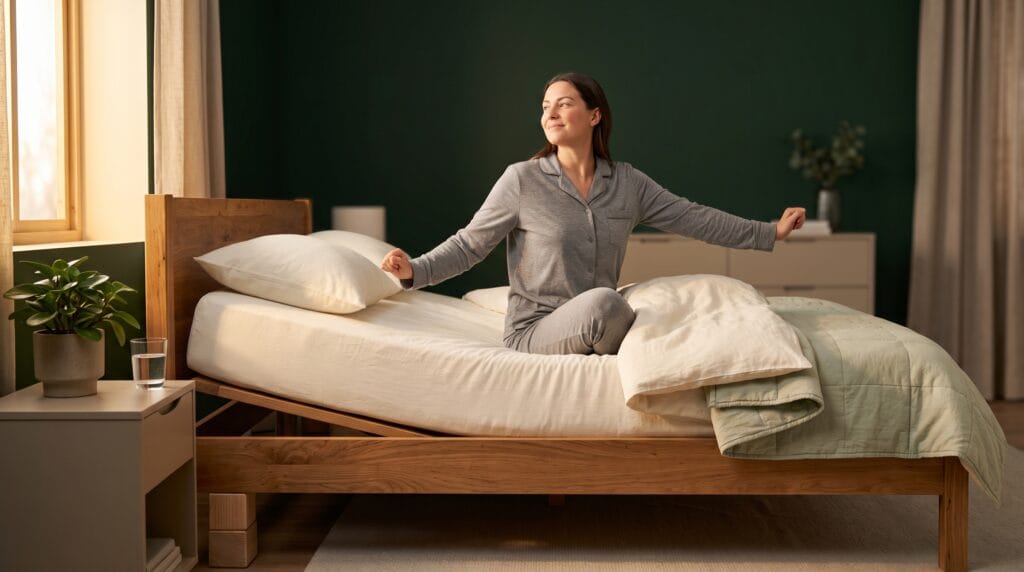
Inclined bed therapy means sleeping with your bed, or just your upper body, tilted so your head sits higher than your feet. You can use bed risers under the head-end legs, a foam wedge, or an adjustable base.
Medical journals call it head of bed elevation. Most studies raise just the head and upper body. Tilting the whole bed, like I do, has been studied far less.
Does Inclined Bed Therapy Help With Acid Reflux?
Gravity keeps stomach acid where it belongs, and lying flat takes that help away. Three studies tested what happens when you give it back.
A randomized crossover trial in Gastroenterología y Hepatología followed 39 people with GERD who were already on medication. Iván Villamil Morales and colleagues (2020) had them sleep 6 weeks with the head of the bed raised 20 cm (about 8 inches) and 6 weeks flat. With the raise, 69% got meaningful symptom relief, versus 33% flat. But quality of life didn’t change, and 54% reported a side effect. The authors wanted more studies before recommending it.
In the Journal of Gastroenterology and Hepatology, Bashir Ahmad Khan and colleagues (2012) measured esophageal acid in 24 people with nighttime reflux, first on a flat bed and again after a week on a 20 cm block. Each person served as their own control. Long reflux episodes (over 5 minutes) fell from 3.3 to 1.0, and 13 of the 20 who finished slept better.
What about people without reflux disease? A randomized trial in the Journal of Clinical Gastroenterology tested 20 healthy volunteers. Erik Person and colleagues (2015) found the least acid exposure after a meal when people slept on an incline with the left side down. That device combined both, so the tilt alone doesn’t get all the credit.
Can Sleeping on an Incline Reduce Snoring and Sleep Apnea?
A raised head keeps the airway more open. In a Journal of Clinical Sleep Medicine study, Grant Owen and colleagues (2024) looked inside the throats of 61 people with sleep apnea. The airway collapsed less easily with the head of the bed raised to 30 degrees.
For snoring, a 2022 study in JMIR Formative Research tracked 25 snorers. Sharon Danoff-Burg and colleagues had them sleep flat for 4 weeks, then at a 12 degree incline for 4 weeks. Snoring time dropped 7%, awakenings fell 4%, and deep sleep rose 5%. Those gains are small, and there was no control group.
For sleep apnea, Fábio Souza and colleagues (2017) tested a 7.5 degree raise in 52 people, reported in Sleep and Breathing. The median apnea-hypopnea index (AHI), the number of breathing interruptions per hour, fell from 15.7 to 10.7. When 7 patients went back to a flat bed, their AHI returned to baseline. Naturally, the benefits only last as long as you keep your bed tilted.
A 2025 pilot randomized trial in Alternative Therapies in Health and Medicine agreed. Sangeun Lee and colleagues found a 7.5 degree adjustable bed improved AHI compared with a flat bed in the 23 people who finished, with no more side effects. It’s small, but it was randomized.
A multicenter observational study from late 2025 in Sleep and Breathing tested a steeper tilt. Antonino Maniaci and colleagues had 30 people with sleep apnea and 30 people without it sleep in three positions in a sleep lab: flat on the back, head raised 30 degrees, and on the side. In the apnea group, AHI fell from 25.7 to 17.8 events per hour, an average drop of 31%. Half of them cut their AHI by at least 50%, about four times the odds seen in the group without apnea. Sleep efficiency also rose, from 73% flat to 79% at 30 degrees. Side sleeping did even better, which shows that position matters in more than one way.
A tilt isn’t a substitute for a sleep study or for CPAP if your doctor prescribed it.
Is Inclined Bed Therapy Healthy if You Don’t Have Reflux or Sleep Apnea?
That’s my situation, so I looked hard here. The honest answer is that we don’t know yet.
Many websites list better circulation, lymphatic drainage, sinus relief, and “detox.” I couldn’t find a clinical trial testing those in healthy sleepers. Fletcher’s blood density theory hasn’t been tested either, and his reports of recovery from spinal cord injury, multiple sclerosis, and Parkinson’s disease come from case stories, not controlled studies. I treat them as interesting, not proven. Some of it is just common sense. Zero gravity is not a great position for sleeping or living in. So why would you do it all night long?
What we do have: healthy volunteers had the least acid exposure on an incline, and the 2025 pilot found no more discomfort than a flat bed. That’s why I stick with it. It’s cheap, easy to undo, and after more than eight years I still sleep well this way. It’s a low-risk experiment you can run yourself.
How Much Should You Incline Your Bed?
The studies used a range. Both reflux trials raised the head end 20 cm (about 8 inches). The apnea trials used 7.5 degrees, the snoring study 12 degrees, and sleep lab work has gone to 30.
Inches and degrees aren’t the same thing, because bed length matters. On a bed about 80 inches long, like a queen, 7 inches under the head-end legs gives about 5 degrees. A 20 cm block under a 2 meter bed comes to roughly 6 degrees, so the reflux trials landed close to my slope.
Sleep guides commonly suggest starting at 3 to 4 inches and working up over a week or two. Sturdy risers under the head-end legs tilt the whole bed. A wedge or adjustable base raises just your upper body.
Are There Negative Effects of Inclined Bed Therapy?
Mostly mild, but not zero.
- Side effects in trials: In the 2020 reflux trial, 54% reported an adverse event. The abstract doesn’t say what they were.
- Adjustment: Sleep guides note extra pressure on the lower joints at first. Starting low helps.
- Sliding toward the foot of the bed: When you wake up during the night, you may need to scoot yourself upward if you don’t have a footbed on your bed.
- Infants: Babies must always sleep flat on a firm surface.
- Talk to your doctor first if you have back, hip, or neck problems, or a heart, lung, or blood pressure condition.
Get the free infographic
Want the science on one page? Download the free Inclined Bed Therapy infographic. It shows the reflux, snoring, and sleep apnea results at a glance, plus a simple guide to setting your bed at 5 degrees. Print it or keep it on your phone.
Download the Free Infographic
Frequently Asked Questions About Inclined Bed Therapy
Is it healthy to sleep on an incline?
For most adults, a mild tilt looks safe, and trials show benefits for reflux, snoring, and sleep apnea. Evidence for healthy sleepers is thin. Check with your doctor first if you have back, heart, or lung problems.
How far should you incline a bed for reflux?
Both trials raised the head end 20 cm (about 8 inches), roughly a 6 degree slope on a standard bed. Start lower and build up.
Does inclined bed therapy help with sleep apnea?
It can reduce it. In 52 people, a 7.5 degree raise lowered the median AHI from 15.7 to 10.7 events per hour. It doesn’t replace a sleep study or CPAP.
Should I tilt the whole bed or just raise my head?
Most trials raised the head end or upper body. I tilt the whole bed at 5 degrees and like it, but I found no trial comparing the two. Tilting the whole bed makes it easy to adjust your sleep style to front, back, or side.
Is it safe to sleep at a 90 degree angle?
That’s sitting up, and none of the studies I found tested it. The sleep trials used tilts from 7.5 to 30 degrees.
Try a 5 Degree Tilt for 30 Days
Raise the head end of your bed 6 to 7 inches, sleep that way for 30 days, and jot down how you feel each morning. Watch your sleep, any reflux or snoring, and any aches. If something feels off, lower it or stop, and talk to your doctor first if you have a health condition.
An adjustable frame would be great because then it would make it easy to sit on your bed when you want to sit on it, and inclined when you want to sleep on it.
Want help putting it into practice?
Sleep is one piece of the puzzle. If you’re managing diabetes, heart disease, or another chronic condition, I’d love to help with the rest. I’m a board-certified health and wellness coach, and I help people turn research like this into daily habits they can stick with.
Learn more about True Wealth Health Coaching